By THL Asa Gormsdottir
TRANSLATION AND DISCUSSION OF A LETTER
DESCRIBING A 1488 NEAPOLITAN WEDDING BANQUET.
Performing Arts Category. Research. Advanced.
Genesis:
In May 1488, Ermolao Barbaro of Milan
wrote to a friend, Pietro Cara of Piedmonte, describing the banquet he attended
for the wedding of Condottiero Gian Giacomo Trivulzio with Beatrice D'Avalos
d'Aquino in Napoli the previous month.
Barbaro's letter, written in Latin, was later discovered by Michael
Nostradamus, who translated it into French in 1552. According to Benporat,
"this is the only surviving document on Neapolitan hospitality of the
entire Quattrocento that will allow us to relive the festivals and banquets
during the time of the Aragonese family" (85, my translation).
I found Nostradamus's translation online and decided to translate it
into English, as the original letter and banquet are contemporary with 1495 Venice and work well with
my overall Pentathlon theme, Lo Sposalizio Del Mare, "The Marriage with
the Sea". In fact, finding this letter was my inspiration for the entire
project.
Process:
I have relied on several dictionaries to
assist in the translation of Barbaro's letter. Where a particular word is in
doubt or worthy of additional explanation, I have added a note. I have also
included relevant biographical and historical detail as needed.
For purposes of comparison I have included the Latin original, as some
difficulties arose that could only be answered by referring to the Latin text.
Each version, Latin, French, English, is included separately with related
comments. I have separated my English translation using the pagination supplied
by the French version. Finally, I have made a table showing all three versions,
for comparison.
I did not refer to any grammatical texts, as many years ago I took my
university degree in French Language and Literature. I have tried to maintain
the recherché flavour of Nostradamus' text and to avoid paraphrasing except
where the English result would be too clumsy.
I have additionally included some comments on the dishes served at
Trivulzio's wedding feast.
Following is the text of the Latin original (Benporat 255):
ERMOLAO BARBARO, ms. Cod.
803, c. 84 sgg., Milano, Biblioteca Trivulziana.
"Letter to Peter
Cara", 6th May 1488 in Epistolae clarorum vivorum selectae,
Colnia, I. Gymnicum sub Monocerote, 1567, c.
131r.
Duxit uxorem clarus bello & pace vir
Trivultius Neapolitanam praenobili famiglia. Invitatus sum ad convivium, immò
ad pontificiam & adipalem coenam. At ego ad epulas primas satur, spectator
potius, quam convivia sui. Credo gratum fore vel tibi, vel posteris, si fercula
quam brevissime descripsero, non ut Macrobius apud nostros, nec ut apud Graecos
Athanaeus iustis voluminis, sed ut occupatus homo, & ad epistolae mensuram.
Primum, aqua minibus data, non ut apud stantibus, sed accumbentibus, utique
rosacea. Tum illati pugillares ex nucleis pineis & saccaro pastillis, item
placentae nucibus, amygdalis, et saccaro confectae, quos vulgo Martios panes
vocamus. Secundum sertum altiles asparagi. Tertium pulpulae ita enim popinae
catillonesque appellant, & iecuscula. Quartum, caro dorcadis tosta. Quintum
capitula iunicarum, vitulorum 've una cum pellibus elixa. Sextum, capi
gallinarum, columborumque pulli, bubilis conitati linguis, & petasonibus,
ac sumine, omnibus elixis, addito limoniacae pultario (sic enim cupediarij
Mediolanenses vocant quam nostri ligurritores Sermiacam). Septimum hoedus
integer tostus, in singulas singuli capidas cum iure, quod ex amaris cerasis
sive, ut quidam manunt appellare, laurocerasis condimenti vice fingitur.
Octavum, tortures, perdices, phasiani, coturnices, turdi, ficeduae, &
omnino plurimi generis avitia, molliter, & studiose tosta, colymbades
olivae condimenti loco appositae. Nonum, gallus gallinaceus tenellus, saccaro
incoctus, & aspergine rosacea madefactus singulis convivis singuli patinas
argenteis, ut &caetera quoque vascula. Decimum, porcellus subrumis integer
tostus in singula singuli crateria issulento quondam liquore persusi. Undecimum
pavi tosti pro condimento leucopheon ius immò ferrugineum eiecinoribus pistis,
& aromate preciosi generis ad portionem, & simmetriam additum: Hispani
… appellant. Duodecimum, tortus orbis ex ovo, lacte, salvia, polline saccareo,
Salviatum voxamus. Tertiumdecimum, strutea cotonea ex saccaro. Quartumdecimum,
carduus pinea, quam scolymon sive cynaram potius appellare convenit.
Quintumdecimum, a lotis manibus mustacea bellaria, collibiae & tragemata
omnis generis saccarea. Inducti mox histriones pantomimi, petauristae,
aretalogi, funambuli, ceraulae, cytharoedi. Singulis porro ferculis praeibant
faces, atque tubae, sub facibus inclusa caveis altilia, quadrumpedes, aviculae,
omnia viventia generis eius, videlicet, cuius ex quae magistri & structores
cocta mensis inferebant. Mense per atrium abacis singulae singulis dispositae.
Ante omnia silentium, quale ne Pythagorici quidem servare potuissent. Vale.
Mediolani, Idibus Maijs 1488.
Comments:
Aside from the food, probably the most
interesting thing about this letter is the classical name-dropping, i.e.
Macrobius and Pythagoras. It may sound pompous and self-conscious to modern
ears, but a classically trained doctor of philosophy such as Barbaro (see entry
next page) could not have done otherwise and maintained his self-respect.
Because the Renaissance was literally the revival of interest in the ideas of
Imperial Rome and Classical Greece, displaying knowledge of such authorities
was, in fact, one's intellectual credentials.
Latin-French Translation (1522):
Following is the translation performed by Michael Nostradamus in 1552
(Gloning).
Hermolaus Barbarus (Ermolao Barbaro)
describes an Italian wedding banquet (1488)
French translation by Michael Nostradamus
1552
-- Text: Vne epistre que Hermolaus Barbarus enuoie à Pierre Cara
Iureconsulte de Milan, en laquelle il descrit le banquet que fut fait aux
nopces du seigneur Triuulce [Title taken from the table]. In: Michel Nostredame
(Nostradamus): Excellent & moult utile Opuscule à touts necessaire, qui
desirent auoir cognoissance de plusieurs exquises Receptes (...). Lyon (Antoine
Volant) 1555, 222-228.
223
HERMOLAVS Barbarus enuoie
salut à Pierre Cara iureconsulte & facondissime Orateur.
Translatée de Latin en
François par maistre Michel Nostradamus.
LE seigneur Triuulce
uaillant home en fait de guerre, & en temps de paix a espousé femme, une dame Neapolitaine d'une tresnoble
y honorable famille. Ie suis esté inuité au conuiue, mais plus tost au soupper
pontificial & sumptueux: mais moy aux premieres uiandes que feurent
apportéez, ie feuz saoul: & faisois plus du spectateur, que
224
du conuiue. Ie pense qu'il te sera bon &
aggreable, ou aux posterieurs, si ie te ueulx descrire les mets, & les
uiandes, non pas ainsi que Macrobe enuers les nostres, ne Atheneus aux Grecz
par grandz uolumes nous a laissé par escrit: mais tout ainsi qu'un homme
occupé, & non excedant la mesure d'une epistre. Premierement l'on donna
l'eau a lauer les mains, mais non pas comme deuers nous l'on fait tout debout,
mais bien elle feut presentée, quand un chascun feut assis, & par tout eau
rose: en apres & tout incontinent feurent apportes le pignolat en tablete
& roche fait de succre, eau rose, & pignons, & puis apres la tartre
& massepan faits de succre, eaue rose, & amandes, que nous appellons
communement pains Martiens. Le second metz
feurent des esparges nouuelles. Le tiers metz
c'estoient le coeur, le foye, & l'estomach des oyseaux, foyage
225
les appellent noz
cuysiniers. Le quatriesme metz
la chair de dain rostie. Le cinquiesme les testes des ienisses & ueaux boullies
auec leurs peaux. Le sixiesme chappons, poulailles, pigeons accompaignez auec
langues de beufz, iambons de truye, le tout bouilly, adiousté auec la saulce du
lymon: ainsi les cuysiniers Milanoys les appellent, ce que nous cuysiniers
Venitiens appellent sermiaque. Le septieme le cheureau tout entire rosty, à un
chascun dens une assiete d'argent, en forme quadrangulaire, auec le ius qui se
fait des cerises amayres, ou comme aucuns aiment mieulx appeller, cerises de
laurier, qui se fait en lieu d'une saulse & condiment. Le huictiesme
tourterelles, perdrix,faisans, cailles, gryues, bequeficz, & de toutes
manieres de uolataille, mollement & studieusement rosties, les oliues
Salonnoises,
226
colymbades feurent mises en lieu de condiment. Le neufuiesme un coq cuit
auec le succre madefié & arrousé auec l'eau rose a un chacun des conuiuéz
dens une petite platine d'argent concaue, ainsi comme toutes les autres
uaisselles. Le dixiesme metz
c'estoit un petit cochon tout entier rosty, à un chacun deux sus un petit uaisseau
escuelle, ou il y auoit une certeine liqueur à chacune uaisselle. Le unziesme
metz c'estoit un paon rosty, & pour son condiment il y auoit une saulse
blanche, ou plus tost ferruginée, qui estoit de foyes pistez, & d'une
precieuse & aromatique composition, adioustée selon la proportion &
simmetrie, les Espagnolz l'appellent Garrouchas. Le douziesme metz c'estoit un monde tortu, &
recroquillé, qui estoit fait d'oeufz, laict, saulge, farine, & succre: nous
l'appellons saulgret.
227
Le treziesme metz estoit cartiers de
coings confitz auec succre, girofle & canelle. Le quatorziesme c'estoient
costes de chardons, pignons, artichaulz, si uous aimes mieulx. Les quinziesme, apres que les mains feurent
lauées, toutes sortes de dragées, comme coriandre, fenoil de Florence, amandre,
anis, giroflat, orengeat, canelat, dragée musquée. Et apres ilz feurent amenes
ioueurs de farces, & comoedies, battelleurs, & ioueurs de goubelletz,
et faiseurs de soubresaulz, ioueurs de bonnes moralitez, chemineurs dessus les
chordes: d'autres qui de leur bouche contrefaisoient toutes sortes d'animaulz,
de toutes sortes d'instrumetz à fleutes, ioueurs de lucqs, orgues, espinetes,
guiternes & psalterions, harpes. En apres à un chacun metz les torches de cyre blanche faites en
parfum & lymnicques demy dorées
228
aloient deuant, & estoient concauez dedens: ou il y auoit de toutes
sortes d'oyseaulx, & autres animaulx de quatre piedz: & d'autant de
sortes qu'il y auoit de touts oyseaulx & autres animaulx cuictz apportéz à
table, autant en y auoit il des uifz: une chacune table estoit adaptée auec ses
sieges & son buffet: & ceux qui seruoient aux priuez, estoient priuez:
les ministres cogneuz aux cogneuz: deuant toutes les autres choses, il y auoit
une silence telle que nul onques de la secte Pythagorique n'y obserua iamais.
Dieu soit auec toy, de Milan ce VI. de May M.CCCC.LXXXVIII.
Michaël Nostradamus
Sextrophæanus
faciebat Salone
litoreæ,
1552.
Comments:
This French is structurally very similar to modern French, although the
style is fairly pedantic and run-on. Some sentence constructions are obscured
by this style, especially when the vocabulary is in doubt. One pitfall to watch
is the many examples where "u" should be read as "v" and
"i" should be read as "g" or "j", which has required
careful re-reading. Nostradamus' spelling is not always standard but exceptions
are obvious for the most part and have not been highlighted.
Comparing the content of the French translation with the Latin original
reveals inconsistencies, as Nostradamus has added details to make his version
more interesting or exciting to read. These include the description of the
bride's family, the scented candles and gilded candlesticks, the list of
candied spice, the multitude of musical instruments, etc.
French-English translation:
223
Ermolao Barbaro1 sends greetings
to Pierre Cara2, jurist and
fluent master of rhetoric.
Translated from Latin into
French by Master Michael Nostradamus.
Lord Trivulzio3 was a valiant warrior, and in peacetime he
married a woman, a Neapolitan lady of a very noble and honourable family. I was
invited to the celebration, in fact to the sumptuous Pontifical4 supper. However, with the first dishes that
were brought to us, I became surfeited5 and became more a spectator than
Comments:
- Ermolao Barbaro (1454—1493) was a Venetian-born scholar primarily
educated in Rome and Professor of Philosophy at the university of Padua (Wikipedia).
- Pierre Cara: "il
giurista ed eminente uomo politico, oltre che sostenitore e promotore
dell’ars artificialiter scribendi in Piemonte, Pietro Cara". (Manunta
103).
- "Né à Milan en 1448, mort à Arpajon en 1518, Giangiacomo
Trivulce marquis de Vigevano, maréchal de France en 1499 est un
condottiere au service de Galéas-Marie Sforza, puis des rois de France
dans les guerres d'Italie, il se distingue à Fornoue en 1495 et à
Marignan, puis tombe en disgrace". (Histoire en Ligne).
- If meant literally, Trivulzio's high rank may indeed have merited
such guests. Otherwise, "pontifical" may simply
mean "grand".
- Literally, "drunk".
224
a guest. I think it would be
good and agreeable for you, or for posterity, if I may describe to you the
dishes, and the meats. Not as Macrobius6 did for ours, nor as (did) Athens for the
Greeks by the great quantities of writing that have come down to us: but as a
busy man, and not exceeding the length of a letter.
First, they gave us water to
wash the hands, not as we normally do standing up, but beautifully presented,
when each was seated, and with pure rosewater. Then, in great measure were
brought squares and chunks of pignolat, made of sugar, rosewater and pine nuts.
Then came the tart and marzipan made of sugar, rosewater and almonds, which we
familiarly call March bread.
The second dish was new
asparagus.
The third dish was the
heart, liver and stomach of birds,
Comments:
- "…their feasts resembled those ancient pontifical banquets
whereof Macrobius speaketh (lib. 3, cap. 13), and Pliny (lib. 10, cap.
10), and which for sumptuousness of fare, long sitting, and curiosity shewed
in the same, exceeded all other men’s feasting…" (Harrison). Also:
"Pliny and Macrobius were ancient scholars and like many
others in early Rome,
among the first gourmands. Their accounts of banquets dating from the 1st
century A.D. describe lavish spreads of exotic foods. The monetary wealth
that was generated by the Romans as they expanded their empire coincided
with an influx of new foods brought from new territories and that
translated to an appreciation for elaborate cooking." (Verjus)
225
which our cooks call foyage7.
The fourth dish was the
roasted flesh of (wild) deer8.
The fifth was the heads of
heifers and calves boiled in their skins9.
The sixth (was) capons,
hens, pigeons accompanied with ox tongues, ham, the whole boiled and adjusted
with lemon sauce. Just as Milanese cooks call them, this is what our Venetian
cooks call sermiaque10.
The seventh (was) venison11 roasted whole, (served) to each in a square
silver plate, with the juice of sour cherries, or as some prefer to call it,
cherries of the laurel12, which acted as a sauce and condiment.
The eighth (was)
turtledoves, partridges, pheasants, quails, grouse13, figpeckers14, and all manner of winged creatures, gently and
carefully roasted, and pickled15 Salonnoise16 olives
Comments:
- Sweetbreads. No direct translation found.
- Dain (alternate spelling daim) meaning fallow deer
(Hindley, Langley & Levy 177). Antelope or gazelle also suggested.
- Possibly a kind of head cheese.
- No translation found, however the cotechino of Modena described by Riley (39) would appear to be an
equivalent.
- Chevreuil closest equivalent found (Raymer 66).
- Bay tree.
- Or thrush.
- Bec-figues in modern French, ficedulae in Latin.
- "Those that are preserued in pickle, called Colymbades, do
dry vp the ouermuch moisture of the stomacke, they remoue the loathing of
meate, stirre vp an appetite; but there is no nourishment at all that is
to be looked for in them, much lesse good nourishment." (Gerard). Estienne's
Seminarium sive plantarium (…) also mentions olivae colymbades (89).
- Lord Judhael (Harvey Wright) suggests Salonnoise could refer to
Salon-de-Provence in France, known as La Salonenque.
226
were used as a condiment.
The ninth (was) a cooked
rooster glazed with sugar syrup17 and sprinkled with rosewater, served to each of
the guests in a little round silver plate, as were all the other dishes.
The tenth dish was a
suckling pig roasted whole, and for each there were two little dishes, and in
each was a special sauce.
The eleventh dish was a
roasted peacock, and for its condiment there was a white sauce, or better yet a
red sauce, made with mashed liver and of a precious and scented flavour, mixed
judiciously and in symmetry. The Spanish call it Garrouchas18.
The twelfth dish was a round
of plaited19 bread, made from eggs, milk, sage, wheat flour
and sugar, which we call saulgret20.
Comments:
- Literally "moistened". Possibly modifié,
converted or refined sugar.
- No translation found.
- Initially I felt that this referred to a subtlety in the shape of
a large sea turtle (tortue) emerging from its shell, but then
re-examined monde, which also means round or ring. In this case tortue
probably means twisted or braided, an appropriate bread for a special
occasion.
- Salviatum in the Latin original. Salvia = sage.
227
The thirteenth dish was
quarters of quince21 preserved with sugar, cloves and cinnamon.
The fourteenth was the leaves22 of wild thistle; artichokes, if you prefer.
The fifteenth, after the
hands were washed, (was) all sorts of comfits, such as coriander, fennel seeds
from Florence,
almonds, anise, cloves, candied orange peel23, cinnamon, and other scented24 sweetmeats25.
And afterwards they called
in players of farces, and comedies, play-fighters, and jugglers, tumblers26, morality players, puppeteers; others who with
their mouths imitated all sorts of animals, all sorts of wind instruments, lute
players, hurdygurdies, spinets, guitars and psalteries, harps. And then to each
place were brought candles of white wax dipped in perfume and embedded in
semi-gilded candlesticks27,
Comments:
- "Small figs" in the Latin.
- I believe costes
should be read as côtes, as in sides or ribs.
- Oranjat alternate spelling (Hindley, Langley
& Levy 456).
- Nutmeg possible flavour (musqué may instead refer to noix
de muscade) (Raymer 190).
- Bellaria in the Latin original, meaning "dessert, including fruit,
nuts, confectionery, sweet wine". (Cassell)
- Summersaulters, literally. The Latin version
suggests contortionists.
- Have used limn, illuminate, as basis. I had considerable
difficulty with lymniques, as the sentence structure could also
suggest gilded bird cages, until I checked the Latin original.
228
and there were cages in
which there were all sorts of birds, and other four-footed animals: and as many
birds and other cooked animals that were brought to the table, so many were
there alive. Each table was set with its chairs and sideboard. And those who
wished to be private, were private: the officials cheek by jowl28. Before everything there was a silence that
none29 of the Pythagorean sect30 will ever see.
God be with you, from Milan this 6th day of May
1488.
Comments:
- The French is muddled here. This is my interpretation.
- Nul oncques, emphatic
negative (Cassells
524).
- Initiates in the Pythagorean school were required to maintain
absolute silence for five years (Liukkonen). The sentence is presumably a
joke, as most wedding banquets are fairly loud affairs.
The Dishes:
Although Benporat suggests that the banquet was an odd melding of North
and South cuisine (86, my translation), most of the dishes are listed in
Platina, whose source, Martino da Como, lived and worked in Northern
Italy:
Pine nut candy (157)
Marzipan pie (379)
Asparagus (223)
Artichokes (195)
Roast chicken (279)
Roast suckling pig (277)
Preserved quince (129)
Roast peacock (277)
Candied spice (157)
Benporat then concedes, "…if one omits the asparagus, the roasted
gazelle (wild deer) and the artichokes, this meal does not substantially
deviate from the standard menu" (86, my translation).
Benporat's examination of several extant banquet menus suggests the
following order of dishes for a grand meal: Sweet meats such as pignolat and
marzipan, several roasted or braised meats, particularly birds such as pheasant
and partridge, finishing with more marzipan and candied spices to sweeten the
breath. This order is present in Trivulzio's wedding banquet, and is further
confirmed by Sanudo in nearby Venice,
who in his Diarii cites with approval weddings serving an abundance of
these specific foods (Labalme and Sanguineti).
Comparison Chart:
On the following pages I have included a chart displaying the Latin,
French and English versions of Barbaro's letter in columns for easy comparison.
Latin
Original (1488)
|
French
Translation (1522)
|
Line
#
|
English
Translation
|
Duxit uxorem clarus bello & pace vir Trivultius
Neapolitanam praenobili famiglia. Invitatus sum ad convivium, immò ad
pontificiam & adipalem coenam. At ego ad epulas primas satur, spectator
potius, quam convivia sui.
|
HERMOLAVS Barbarus enuoie
salut à Pierre Cara iureconsulte & facondissime Orateur.
Translatée de Latin en François par maistre Michel Nostradamus.
LE seigneur Triuulce
uaillant home en fait de guerre, & en temps de paix a espousé femme, une dame Neapolitaine d'une tresnoble
y honorable famille. Ie suis esté inuité au conuiue, mais plus tost au
soupper pontificial & sumptueux: mais moy aux premieres uiandes que
feurent apportéez, ie feuz saoul: & faisois plus du spectateur, que
|
223
|
Ermolao Barbaro sends
greetings to Pierre Cara, jurist and fluent master of rhetoric.
Translated from French
into English by Lady Asa Gormsdottir.
Lord Trivulzio was a
valiant warrior, and in peacetime he married a woman, a Napoletan lady of a
very noble and honourable family. I was invited to the celebration, in fact
to the sumptuous Pontifical supper. However, with the first dishes that were
brought to us, I became surfeited and became more a spectator than
|
Credo gratum fore vel tibi, vel posteris,
si fercula quam brevissime descripsero, non ut Macrobius apud nostros, nec ut
apud Graecos Athanaeus iustis voluminis, sed ut occupatus homo, & ad
epistolae mensuram.
Primum, aqua minibus data, non ut apud
stantibus, sed accumbentibus, utique rosacea. Tum illati pugillares ex
nucleis pineis & saccaro pastillis, item placentae nucibus, amygdalis, et
saccaro confectae, quos vulgo Martios panes vocamus.
Secundum sertum altiles asparagi.
Tertium pulpulae ita enim popinae
catillonesque appellant, & iecuscula.
|
du conuiue. Ie pense
qu'il te sera bon & aggreable, ou aux posterieurs, si ie te ueulx
descrire les mets, & les uiandes, non pas ainsi que Macrobe enuers les
nostres, ne Atheneus aux Grecz par grandz uolumes nous a laissé par escrit:
mais tout ainsi qu'un homme occupé, & non excedant la mesure d'une
epistre.
Premierement l'on donna
l'eau a lauer les mains, mais non pas comme deuers nous l'on fait tout
debout, mais bien elle feut presentée, quand un chascun feut assis, & par
tout eau rose: en apres & tout incontinent feurent apportes le pignolat en
tablete & roche fait de succre, eau rose, & pignons, & puis apres
la tartre & massepan faits de succre, eaue rose, & amandes, que nous
appellons communement pains Martiens.
Le second metz feurent des
esparges
nouuelles.
Le tiers metz c'estoient le coeur,
le foye, & l'estomach des oyseaux, foyage
|
224
|
a guest. I think it
would be good and agreeable for you, or for posterity, if I may describe to
you the dishes, and the meats. Not as Macrobius did for ours, nor as (did) Athens for the Greeks
by the great quantities of writing that have come down to us: but as a busy
man, and not exceeding the length of a letter.
First, they gave us
water to wash the hands, not as we normally do standing up, but beautifully
presented, when each was seated, and with pure rosewater. Then, in great
measure were brought squares and chunks of pignolat, made of sugar, rosewater
and pine nuts, and then after the tart and marzipan made of sugar, rosewater
and almonds, which we familiarly call March bread.
The second dish was new
asparagus.
The third dish was the
heart, liver and stomach of birds,
|
Quartum, caro dorcadis tosta.
Quintum capitula iunicarum, vitulorum 've
una cum pellibus elixa.
Sextum, capi gallinarum, columborumque
pulli, bubilis conitati linguis, & petasonibus, ac sumine, omnibus
elixis, addito limoniacae pultario (sic enim cupediarij Mediolanenses vocant
quam nostri ligurritores Sermiacam).
Septimum hoedus integer tostus, in singulas
singuli capidas cum iure, quod ex amaris cerasis sive, ut quidam manunt appellare,
laurocerasis condimenti vice fingitur.
Octavum, tortures, perdices, phasiani,
coturnices, turdi, ficeduae, & omnino plurimi generis avitia, molliter,
& studiose tosta, colymbades olivae condimenti loco appositae.
|
les appellent noz
cuysiniers.
Le quatriesme metz la chair de dain
rostie.
Le cinquiesme les testes
des ienisses & ueaux boullies auec leurs peaux.
Le sixiesme chappons,
poulailles, pigeons accompaignez auec langues de beufz, iambons de truye, le
tout bouilly, adiousté auec la saulce du lymon: ainsi les cuysiniers Milanoys
les appellent, ce que nous cuysiniers Venitiens appellent sermiaque.
Le septieme le cheureau
tout entire rosty, à un chascun dens une assiete d'argent, en forme
quadrangulaire, auec le ius qui se fait des cerises amayres, ou comme aucuns
aiment mieulx appeller, cerises de laurier, qui se fait en lieu d'une saulse
& condiment.
Le huictiesme
tourterelles, perdrix,faisans, cailles, gryues, bequeficz, & de toutes
manieres de uolataille, mollement & studieusement rosties, les oliues
Salonnoises,
|
225
|
which our cooks call
foyage.
The fourth dish was the
roasted flesh of deer.
The fifth was the heads
of heifers and calves boiled in their skins.
The sixth (was) capons,
hens, pigeons accompanied with ox tongues, ham, the whole boiled and adjusted
with lemon sauce. Just as Milanese cooks call it, this is what our Venetian
cooks call sermiaque.
The seventh (was)
venison roasted whole, (served) to each in a square silver plate, with the
juice of sour cherries, or as some prefer to call it, cherries of the laurel,
which acted as a sauce and condiment.
The eighth (was)
turtledoves, partridges, pheasants, quails, grouse, figpeckers, and all
manner of winged creatures, gently and carefully roasted, and pickled
Salonnoise olives
|
Nonum, gallus gallinaceus tenellus, saccaro
incoctus, & aspergine rosacea madefactus singulis convivis singuli
patinas argenteis, ut &caetera quoque vascula.
Decimum, porcellus subrumis integer tostus
in singula singuli crateria issulento quondam liquore persusi.
Undecimum pavi tosti pro condimento
leucopheon ius immò ferrugineum eiecinoribus pistis, & aromate preciosi
generis ad portionem, & simmetriam additum: Hispani … appellant.
Duodecimum, tortus orbis ex ovo, lacte,
salvia, polline saccareo, Salviatum voxamus.
|
colymbades feurent mises
en lieu de condiment.
Le neufuiesme un coq
cuit auec le succre madefié & arrousé auec l'eau rose a un chacun des
conuiuéz dens une petite platine d'argent concaue, ainsi comme toutes les
autres uaisselles.
Le dixiesme metz c'estoit un petit
cochon tout entier rosty, à un chacun deux sus un petit uaisseau escuelle, ou
il y auoit une certeine liqueur à chacune uaisselle.
Le unziesme metz
c'estoit un paon rosty, & pour son condiment il y auoit une saulse
blanche, ou plus tost ferruginée, qui estoit de foyes pistez, & d'une
precieuse & aromatique composition, adioustée selon la proportion &
simmetrie, les Espagnolz l'appellent Garrouchas.
Le douziesme metz c'estoit un monde
tortu, & recroquillé, qui estoit fait d'oeufz, laict, saulge, farine,
& succre: nous l'appellons saulgret.
|
226
|
were used as a
condiment.
The ninth (was) a cooked
rooster glazed with sugar syrup and sprinkled with rosewater, served to each
of the guests in a little round silver plate, as were all the other dishes.
The tenth dish was a
suckling pig roasted whole, and for each there were two little dishes, and in
each was a special sauce.
The eleventh dish was a
roasted peacock, and for its condiment there was a white sauce, or even
better a red sauce, made with mashed liver and of a precious and scented
flavour, mixed judiciously and in symmetry. The Spanish call it Garrouchas.
The twelfth dish was a
round of plaited bread, made from eggs, milk, sage, wheat flour and sugar,
which we call saulgret.
|
Tertiumdecimum, strutea cotonea ex saccaro.
Quartumdecimum, carduus pinea, quam
scolymon sive cynaram potius appellare convenit.
Quintumdecimum, a lotis manibus mustacea
bellaria, collibiae & tragemata omnis generis saccarea.
Inducti mox histriones pantomimi, petauristae,
aretalogi, funambuli, ceraulae, cytharoedi. Singulis porro ferculis praeibant
faces, atque tubae,
|
Le treziesme metz estoit cartiers de
coings confitz auec succre, girofle & canelle.
Le quatorziesme
c'estoient costes de chardons, pignons, artichaulz, si uous aimes mieulx.
Les quinziesme, apres
que les mains feurent lauées, toutes sortes de dragées, comme coriandre,
fenoil de Florence, amandre, anis, giroflat, orengeat, canelat, dragée
musquée.
Et apres ilz feurent
amenes ioueurs de farces, & comoedies, battelleurs, & ioueurs de
goubelletz, et faiseurs de soubresaulz, ioueurs de bonnes moralitez,
chemineurs dessus les chordes: d'autres qui de leur bouche contrefaisoient
toutes sortes d'animaulz, de toutes sortes d'instrumetz à fleutes, ioueurs de
lucqs, orgues, espinetes, guiternes & psalterions, harpes. En apres à un
chacun metz
les torches de cyre blanche faites en parfum & lymnicques demy dorées
|
227
|
The thirteenth dish was
quarters of quince preserved with sugar, cloves and cinnamon.
The fourteenth was the
leaves of wild thistle; artichokes, if you prefer.
The fifteenth, after the
hands were washed, (was) all sorts of comfits, such as coriander, fennel
seeds from Florence,
almonds, anise, cloves, candied orange peel, cinnamon, and other scented
sweetmeats.
And afterwards they
called in players of farces, and comedies, play-fighters, and jugglers,
(tumblers) tumblers, morality players, puppeteers; others who with their
mouths imitated all sorts of animals, all sorts of wind instruments, lute players,
hurdygurdies, spinets, guitars and psalteries, harps. And then to each place
were brought candles of white wax dipped in perfume and embedded in
semi-gilded lanterns.
|
sub facibus inclusa caveis altilia,
quadrumpedes, aviculae, omnia viventia generis eius, videlicet, cuius ex quae
magistri & structores cocta mensis inferebant. Mense per atrium abacis
singulae singulis dispositae. Ante omnia silentium, quale ne Pythagorici
quidem servare potuissent.
Vale. Mediolani, Idibus Maijs 1488.
|
aloient deuant, &
estoient concauez dedens: ou il y auoit de toutes sortes d'oyseaulx, &
autres animaulx de quatre piedz: & d'autant de sortes qu'il y auoit de
touts oyseaulx & autres animaulx cuictz apportéz à table, autant en y
auoit il des uifz: une chacune table estoit adaptée auec ses sieges & son
buffet: & ceux qui seruoient aux priuez, estoient priuez: les ministres
cogneuz aux cogneuz: deuant toutes les autres choses, il y auoit une silence
telle que nul onques de la secte Pythagorique n'y obserua iamais.
Dieu soit auec toy, de
Milan ce VI. de May M.CCCC.LXXXVIII.
|
228
|
There were cages in
which there were all sorts of birds, and other four-footed animals. As many
birds and other cooked animals that were brought to the table, so many were
there alive. Each table was set with its chairs and sideboard. And those who
wished to be private, were private: the officials cheek by jowl: Before
everything there was a silence that none of the Pythagorean sect will ever
witness.
God be with you, from Milan this 6th day of
May 1488.
|
WORKS
CITED
Barbaro, Ermolao. "Letter to Pierre Cara". Milan: 1488. Trans. Michael Nostredamus. Excellent
& moult utile Opuscule à
touts necessaire, qui desirent auoir cognoissance de plusieurs
exquises Receptes (…). Lyon: Antoine Volant, 1555. 2001. Thomas Gloning. 14 Oct.
Benporat, Claudio. Feste e banchetti: convivialità Italian fra Tre e
Quattrocento. Firenze: L.S.
Olschki, 2001.
Cassell's French-English, English-French Dictionary. 1981.
Cassell's Italian-English, English-Italian Dictionary. 1965.
Cassell's new Latin-English, English-Latin Dictionary. 1959.
"Ermolao Barbaro". Wikipedia the Free Encyclopedia Online.
2003. Wikipedia UP. 20 Oct. 2003
Estienne, Charles. Seminarium sive plantarium earum arborum (…).
Mid-16th C. Gallica: la bibliothèque
numérique. 1995. 23 Oct. 2003.
<http://gallica.bnf.fr/scripts/ConsultationTout.exe?O=N054240>.
Harrison, William. "Of the Food and Diet of the English ". A
Description of Elizabethan England.
Hindley, Langley & Levy. Old French – English Dictionary.
2000 ed.
Labalme, Patricia H. and Laura Sanguineti. "How to (and how not
to) get married in sixteenth-
century Venice
(Selections from the diaries of Marin Sanudo)." Renaissance
Quarterly.
52 (Spring 1999): 43-72.
Latin Dictionary and Grammar Aid. University of Notre
Dame. 15 Sep. 2003. 23 Oct. 2003.
<http://www.nd.edu/~archives/latgramm.htm>.
Le Micro-Robert: dictionnaire d'apprentissage de la langue francaise. 2nd
ed. 1989.
Liukkonen, Petri. " Pythagoras
(570?-495? B.C.)". 2002. 23 Oct. 2003.
<http://www.kirjasto.sci.fi/calendar.htm>.
"Louis XII dit le Père du Peuple". L'Histoire en Ligne Online. 2002.
L'Histoire en Ligne UP. 20
Manunta, Maria Rosaria. Angelo Carletti tra storia e devozione.
1996. 21 Oct. 2003.
Milham, Mary Ella. Platina, On Right Pleasure and Good Health: a
critical edition and translation
of De honesta voluptate et
valetudine. Tempe: Medieval &
Renaissance Texts &
Studies, 1998.
Raymer, Leslie. Dictionary of Foods and Food Processes: English,
German, French, Spanish,
Italian. Surrey: Food Science Publishers, 1990.
Renfrow, Cindy. Culinary gleanings from John Gerard's Herball or
General Historie of Plantes,
Webster's Collegiate Dictionary. 5th ed. 1942.
Wright, Harvey. Personal correspondence.
Note:
I recently found an online reference to Barbara Santich's The
Original Mediterranean Cuisine (Prospect Books, 1995) that cited Barbaro's
letter and listed some of the dishes. However, the reference <http://www.drizzle.com/~celyn/mrwp/faq6.html>
incorrectly identified several dishes, so I have deliberately avoided this
book.
1495 VENETIAN OVER- AND UNDER-DRESSES,
HANDMADE IN SILK
Textile and Needle Arts Category. Costuming: European: 1451-1600. Advanced.
BACKGROUND
According to Sanudo, upper class ladies normally confined themselves to
balcony or window (Newton
48, 162) and did not display themselves on the streets or in the campi. In
regards to the Wedding with the Sea, Felix Fabri, a pilgrim who witnessed the
rite in 1483, indicates that no women were carried on the ducal galley, the
Bucintoro, or in the other reviewing ships:
"After the blessing and
espousal of the sea is over they row the Bucentaur towards the monastery of St.
Nicholas on the Lido, and on reaching the shore there all disembark from all
the ships and enter the church, which not a hundredth part of the people is
able to enter, though it is a great church; and in all that multitude there is
not one single woman, but the whole ceremony is performed by men alone."
(Fabri)
One hundred years later, we know that courtesans did attend the rite
from nearby boats. In 1617 Sir Henry Wooton reported that the Senate had
forbidden the appearance of courtesans on the water for the rite: "…a
decree made at the suit of all the gentlewomen, who before were
indistinguishable abroad from those baggaes" (Muir 133), a fact proven by
Vecellio's costume sketches in which Venetian Matron, Venetian Bride and
Venetian Courtesan seem to wear the same clothes.
Whether or not she was on the water or attending a sanctioned Sensa
feast by one of the Compagnie della Calza, in 1495 a lady of good class would
need a fashionable new gown for this important holiday.
1.
Description
Set of handsewn under- and overdresses of burnt
peach and dark copper silk, lined with linen and imitation gold tissue,
embellished with pearls and garnets, accompanied by matching finestrella
sleeves. The dress is designed to be the height of fashion for 1495.
These dresses would be laced over a low-necked,
gathered linen camisa with wide sleeves. Accessories would include pearl
necklaces, earrings, a narrow belt, zoccoli (Venetian platform shoes), and an
elaborate hairstyle.
2.
Construction
a)
Pattern
No gowns are known to have survived from late
15th century Venice.
Without extant pieces, I have relied on pictorial evidence for "the
typical high-waisted dress of Venetian women recorded in the great Scuole
paintings of the end of the fifteenth century" (Newton 48) and written reports by visiting
pilgrims. These sources include:
·
Albrecht Durer
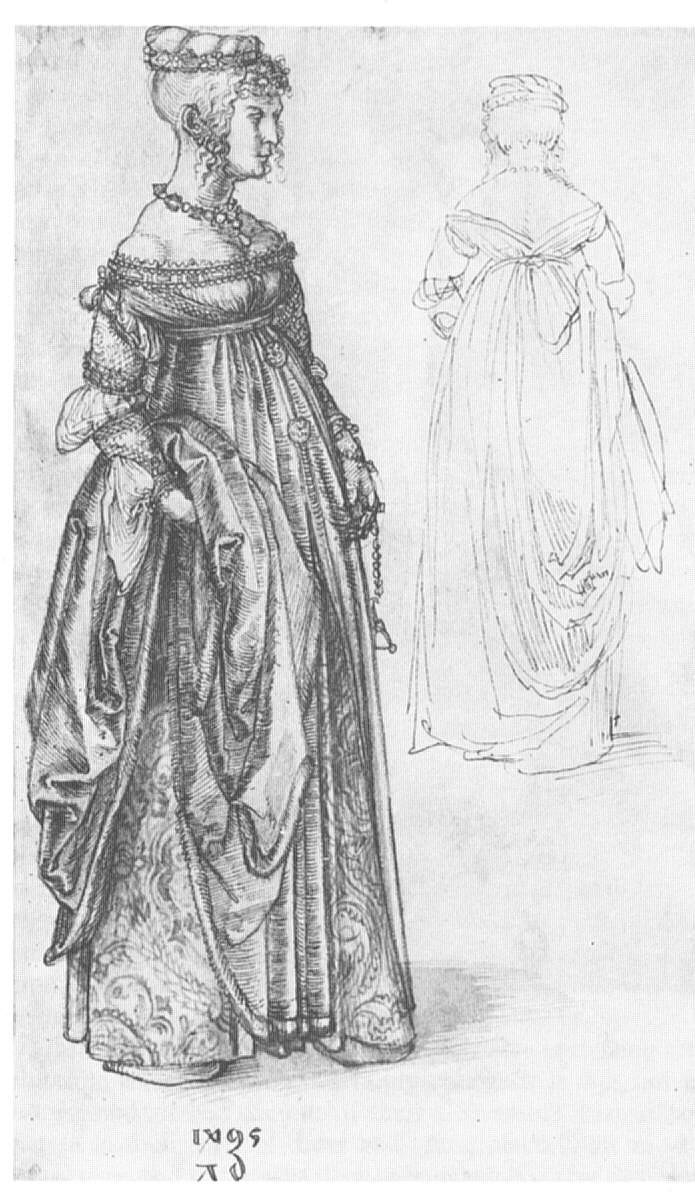
"Durer's drawing of a Venetian woman is
… more richly jewelled than one would have thought possible in view of the
prevailing sumptuary laws, her dress belongs to exactly the same moment in
fashion as the dresses worn by the two courtesans (Carpaccio). Its low
neckline allows only a minute strip of stuff on the shoulder; its sleeves are
made up of segments held together by laces; through their gaps the full sleeves
of her chemise emerge in light puffs." (Newton 52)
Albrecht Durer's sketch is my primary
inspiration for this dress. A copy is
included.
·
Vittore Carpaccio (several works)
Carpaccio is responsible for several
paintings which show the dress, in particular Two Venetian Courtesans
and the St. Ursula fresco series. The two women in the former wear deeply
coloured dresses in plain silk and velvet. The sleeves on the second lady have
been cut from a richly patterned brocade. The hems of both are decorated with
trim. Their low necklines are decorated with large pearls and the sleeves of
the first lady are also decorated with small pearls along the openings. A copy
is included.
·
Freschi illumination
The Memorie della famiglia Freschi
portrait series (Zorzi 216-219), dated late 15th/early 16th
century, includes two portraits of Venetian women, in particular that of
Dorothea Zacarias. Dorothea's outfit is very similar in construction to that in
Albrecht Durer's sketch, composed of a pair of dresses. This illumination is
an important find that to my knowledge has not been cited anywhere else. A
copy is included.
The under-dress is apparently made of a
gold-coloured brocade. The bodice is edged with pearls in a solid line around
the neckline.
The over-dress is made of a dark material
(dark brown, purple or black), lined with a green patterned material that is
exposed by front and side parts. The neckline is appliquéd with a wide band of
gold-coloured material, which has been beaded with pearls and ornate
flower-like roundels.
The bride wears one-piece open-work sleeves,
tied at intervals. Additionally, there appears to be long hanging sleeves that
flow to the floor. Finally, the bride wears the same bunned hairstyle and
lavish jewellery shown in Durer and Carpaccio.
·
Giovanni Mansueti
A number of examples of the dress are found
in Giovanni Mansueti's Miracle of the Bridge at San Lio (1494) (Hills
16). There is a back view of a woman kneeling in the foreground, who is wearing
a low-cut brown dress belted under the bust, accessorized by a coral necklace
and bunned hair. No lacing lines are visible. Her camisa poufs from the left
elbow of her finestrella sleeve and the pleating in her full skirt is visible.
A copy is included.
Several other ladies are shown watching the
scene from their windows or balconies. All are wearing the same low-cut style,
apparently laced in front, with an attached pleated skirt, necklace and
uniformly bunned hair. The orange, red, brown, dark brown or black dresses are
very low on the shoulders, with the camisa escaping at the shoulders where the
sleeves have been tied on by ribbons. Some of the dresses show front lacings.
·
Gentile Bellini
Another back view of the dress can be found
in Gentile Bellini's Procession of the Reliquary of the True Cross in Piazza
San Marco (1496) (Herald 174). The painting clearly shows the v-shape of
the over-dress revealing the line of the under-dress.
Some limited frontal views of the dress can
be found in Gentile Bellini's Miracle at the Bridge of San Lorenzo
(1500) (Hills 174). Behind the line of Cypriot ladies attending Queen Caterina
Cornaro there are a number of Venetian ladies. At this later date the hairstyle
has changed somewhat, but the bodice is largely the same.
·
Other Paintings
Another
Scuole painting, familiarly known as The Engagement (Bestetti 103), shows a
slightly earlier and less extreme version of the dress with the overdress
parting to expose the underdress.
I also
consulted Vecellio’s costume portfolio (1599), which includes examples of “old
style” Venetian dress. However, his sketches date 100 years later than the
style I am using. His sketches are therefore unreliable for 1495, and the
dresses shown conform only vaguely to the contemporary portraits.
·
Betrothal glass
A late 15th century Venetian
enamelled glass (Hills 125) has a good side view of the dress. This goblet
shows the same tight bodice, almost slipping off the shoulders, with a high
waist and a decorative band along the neckline. The woman wears her hair in the
same bunned style with curly ringlets, and a pair of pearl necklaces. A
copy is included.
·
Eye-witness accounts/journals
I have also referred to the
following pilgrim accounts for details on the dress:
Casola, Canon Pietro. Pilgrimage to Jerusalem in the Year
1494.
Fabri, Felix. The Wanderings of Felix
Fabri. (1483).
Harff, Arnold
von. Pilgrimage of Arnold von Harff. (1497).
b)
Bodice
The bodices shown are very high waisted,
sometimes extremely low-necked/backed, sometimes off-the-shoulder (Durer in
particular). At first I was concerned that the neckline had been exaggerated by
the artists, but Casola's eyewitness account confirms the look:
"These Venetian women, especially the
pretty ones, try as much as possible in public to show their chests--I mean the
breasts and shoulders--so much so, that several times when I saw them I
marvelled that their clothes did not fall off their backs." (Casola
142-145)
The very high-waisted bodices for
this period appear not to have any boning and rely on cut and tight lacing for
support. Normally the overdress bodice is cut in a v front and back to expose
the material of the underdress.
I draped and fitted a template bodice using
linen and then drew a paper pattern. I then cut the peach silk for the
underbodice and the copper silk and orange taffeta silk lining for the
overbodice from this pattern. In each case I tried to maximize the effects of
the brocade patterns.
c)
Skirt
All the skirts shown are full to the floor,
pleated or gathered to the high waist. The skirt of the overdress is usually
open from the waist down.
I completely finished the fully lined skirts before attaching them to
the bodices. Tiny whipstitches (15-20 per inch) were used to attach the lining
at top and bottom and give a sharp edge. The join in the underskirt was sewn in
three layers with the fourth layer hemmed down. The overskirt edges were folded
over and hemmed down.
Each finished skirt was then
roll-pleated to a linen strip, which was then sewn into the lining of each
bodice. This provided strength, especially for the heavier underdress. Rolled
pleating, knife pleating, and gathering are all shown in the artwork. I used
roll pleating because of the quantity of material.
The sari material used for the
skirts includes a woven border, avoiding the need to apply trim.
d)
Sleeves
Sleeves are shown tied to the bodice by
ribbon points in some portraits and sewn on in others. I have chosen tie-on
sleeves. Durer’s sketch clearly shows two-piece openwork sleeves that lace
together at the elbow. This design is very attractive and I have used it on
these sleeves. Normally only one pair of sleeves is worn at a time – the
voluminous chemises peek out in all the portrait examples.
The sleeves were cut to maximize the silk’s
existing brocade pattern. In the portraits the sleeves are made from elaborate
brocade that matches the underdress. I could have elected to include hanging
sleeves as shown in the Freschi illumination, but so far this is my only source
for hanging sleeves with this dress and the identification is not confirmed.
3.
Fabric
a)
Exterior
For the exterior I used two silk
brocade saris that I received as an anniversary present.
The silk industry was very
important to Venice
in this period. Venice
had built the industry on the expertise of Luccan refugees: "Venetian
production by then (1462) dominated the market. In describing the life of Doge
Tommaso Mocenigo, Marin Sanudo explicitly states that the products of Lucca and her wealth had passed to Venice,
and that Lucca
was in decline". (Santangelo 29)
Naturally, Venice took steps to
protect it: "The Great Council and Senate … pronounced … decrees … against
importing into the Venetian Republic silk stuffs not produced in Venice (July
13, 1410)" (Santangelo 28). Such prohibitions were renewed:
"…while
Venice exported
fine silks to other countries, she also imported or at least shipped silk
fabrics from abroad. Restrictions on these were severe. In 1490, the Senate
decreed that no zentilhome, citadin, or habitante of Venice or her dominions
on the mainland was to wear or to use in any way any cloth of gold, silver or
silk which had not been manufactured in questa città". (Newton 175)
With these rules, an upper class
Venetian lady would legitimately only be able to use Venetian-made silk for
such a dress. However, sumptuary laws are usually created to correct rather
than confirm behaviour.
In review of extant silk brocade fragments
from Venice and other parts of Italy, several pieces for the 14th
and 15th century (largely ecclesiastical survivals) show
large-pattern vertical pineapple/lotus/tree-of-life ("pomegranate") designs
in jewel-tone velvets (red or purple especially) with gold brocading, as well
as other highly stylized flower in-and-out progressions (examples from
Santangelo, Poli and Dupont-Auberville).
"The fabrics surviving from the first
half of the 14th century, largely samites, diaspes and lampases are
enriched with vegetal and floral elements of Chinese or Oriental inspiration,
like the peony, the lotus, and tree of life. Those of the second half of the
century are more dynamic and lively with added animal elements such as the
fawn, the eagle, mastiff, leopard, pelican, caught in animated and realistic
attitudes". (Poli 41)
In recent times, select Italian boutique
manufacturers have revived these distinctive patterns, but the cost is
prohibitive – sometimes thousands of dollars per yard.
At the other end of the scale, some modern
synthetic upholstery brocades use the pineapple design. In my opinion, these
heavy fabrics are inappropriate for this silken dress.
Silk sarees from India and Pakistan are currently the most
accessible and affordable source for silk brocade in quantity, and have the
correct weight for this dress.
Although sarees often have flower
patterns, I have not found any with the distinctive pineapple design. The
Islamic prohibitions continue to be maintained in weaving Eastern silk sarees
and I have not found any examples with heraldic beasts either.
On the other hand, the peach silk
saree I used is similar in design and colour to a 14th century
Venetian remnant (Santangelo, Plate 25). Additionally, the lavish acanthus-like
borders on these sarees also resemble border elements in illuminated
manuscripts of the same period (which took them from classical architecture).
Finally, it is entirely possible that
imported Turkish silks with similar characteristics to my sarees legitimately
made their way into Venetian clothing, despite the prohibitions, as gifts or
souvenirs through Venice's long diplomatic
relationship with Turkey.
In this context I have decided to use the
silk sarees as the best middle ground choice.
b)
Linings:
- Medium-weight
white linen was used to line the underdress and for the pleating strips.
This is a period choice.
- Yarn-dyed
silk taffeta was used to line the bodice and sleeves of the overdress.
This is a period material.
- Imitation
gold tissue was used to line the skirt of the overdress. Cloth of gold was
routinely banned by Venetian sumptuary laws: "…regulations governing
expenditure on the fabrics … certainly ruled out not only clothing of gold
or silver stuffs but also embroidery in precious metal threads and
expensive silk cloths." (Newton
52). However, these laws were frequently ignored or bypassed by various
loopholes. Using imitation gold tissue to line a skirt is a way to cock a
snoot at the sumptuary law.
4.
Colour
I have used orange-tone silks for these
dresses.
The brown-orange-yellow palette was coming
into vogue in Venetian painting during the late 15th century.
"Orange
had not been used as a colour term by Petrarch or Boccaccio: Italians refer to
the yolk of egg as rosso d'uovo, so it is likely that any yellow deeper
than crocus was traditionally categorized as red. But in the Hypnerotomachia
Poliphili, published in Venice
in 1499, the adjective naranceo is frequently used to describe the
orange-coloured. Thereafter naranzin becomes a colour in dress…So
orange, fruit and colour, was in the ascendant in Renaissance Venice".
(Hills 146-150)
Manuseti's Miracle (…) shows
orange-tone dresses, but this may simply be part of the palette he chose for
the painting rather than an actual model.
With orange, yellows and browns being
increasingly used in portraits, tile and maiolica on the cusp of the
Cinquecento, it is reasonable and highly fashionable to use the burnt peach and
dark copper silks for this 1495 dress.
5.
Finishing
a)
Stitches used
These dresses are entirely hand sewn. Because
no 15th century Venetian clothing has survived, I have referred to
construction techniques used in the extant 16th century garments
discussed in Janet Arnold’s Patterns of Fashion, using running stitch, back
stitch and whip stitch as needed.
Although written almost a century later,
Tomaso Garzoni's Piazza universale lists a number of stitches and
finishing techniques that might have been used in 1495 Venice:
"La fatica dell'arte accresce medesimamente
la dignita de' sartori, perche cotesto mestieri, oltra che e pieno di mille
varieta di punti, come di semplici, di doppii, di punto allacciato, di drieto
punto, di gase, di cadenelle, di gippature; et porta seco diversita
d'ornamento, perche chi vuol liste, chi cordoni, chi franzette, chi passamano,
chi tagli, chi cordella, chi raso, chi cendado, chi velluto, chi nastro di
seta, chi treccietta d'oro; non ha mai fine, et mai si fornisce d'imparare
quanto alla forma degli habiti, I quail alla giornata si variano tanto, chi I
sartori ne sanno meno in lor vecchiezza, che sul principio che aprono
bottega". (Garzoni 999)
Possible translations (Boerio, Cassells) for
these stitches include:
·
Punto di semplici (’simple" or running stitch)
·
Punto di doppii ("double" stitch)
·
Punto allacciato ("connected point",
"tied", "laced/interlinked", possibly cross stitch)
·
Drieto punto: (likely zig zag stitch)
Drièdo
-> Drièto -> Drio
Reverse
of "innanzi" (forward)
"far un drio l'altro" –
alternare, operare scambievolmente, a vicenda (Boerio 248).
-> to perform reciprocally,
in turn = back and forth.
·
Punto di gase: (back stitch?)
"Gaso s.m. Voce fam. Donnesca
e ancho de'Sartori, Punto addietro, il quale si fa introdcendo l'ago nella
stoffa, facendolo passare ad alcuni fili di distanza, poi tornandolo ad
introdurre sullo stesso punto in cui era stato introdutto prima, e poscia
passandolo ad alcuni fili di distanza dal luogo in cui fu passato da
prima." (Boerio 300)
·
Punto di cadenelle ("necklace", chain
stitch)
b)
Thread
Gold-coloured
silk thread (bodices and beading) (authentic and strong)
White linen thread (bodice, pleating strips,
eyelets) (authentic and strong)
Orange synthetic thread (skirt and
sleeve construction) (strength, low cost, matches fabric)
c)
Needles
Modern
hand sewing and beading needles were used throughout.
d)
Beading/jewels
15th century Venetian ladies wore
a profusion of jewels, and their necklines and sleeves were frequently jewelled
or beaded:
"Those who can afford it, and also those
who cannot, dress very splendidly, and have magnificent jewels and pearls in
the trimming round their collars. They wear many rings on their fingers with
great balass rubies,' rubies and diamonds. I said also those who cannot afford
it, because I was told that many of them hire these things." (Casola
142-145)
"I was in fact informed by a
merchant, who pointed out to me a young and wealthy citizen's wife with her
neck and hands covered with countless costly and beautiful jewels, that in his
opinion the jewels were worth more than 600,000 ducats." (von Harff)
Neckline
Neckline beading, especially using a line of
large round pearls, is shown in the Durer sketch and in Carpaccio's Two
Venetian Courtesans. In the meeting scene between the saint and her fiancé from
Carpaccio's St. Ursula cycle (Meeting of the Betrothed Couple, Bestetti
149), the saint's dress is lavishly beaded with large pearls along the
necklines of both dresses. Pearls were prized by the Venetians.
Another
example of neckline beading is found in Carpaccio's Portrait of a Lady
(Bestetti 162), a rather dour looking woman. The neckline of her underdress
boasts 2x4 groupings of pearls at intervals, while the overdress is studded
alternately with large pearls and gold plaques.
Neroccio di Bartolomeo's Portrait
of a Lady (possibly Alessandra Piccolomini (Bestetti 148)), shows a neckline
decorated with small pearls sewn in clusters of three at intervals.
Finally, the neckline in the
Freschi illumination seems to have been appliquéd with roundel or flower shapes.
I appliquéd a decorative strip
(taken from the edge of the saree) to the neckline of the underdress and then
beaded it with small freshwater pearls and garnets. I also used five gold
bullion flowers (as per Freschi). The neckline of the overdress didn't need
embellishing as the material was very busy and would not have benefited from
it.
Sleeves
The finestrella sleeves in
Carpaccio's Two Venetian Courtesans have been beaded with small pearls around
the openings.
As well, the left sleeve on
Carpaccio's St. Ursula (Meeting of the Betrothed Couple) bears a large
rectangular jewel in a heavy gold setting surrounded by pearls.
Pinning a brooch would achieve the
same effect as St. Ursula's sleeve.
e)
Eyelets
Eyelets overcast with linen thread are the
most common period bases for lacing (Arnold,
numerous photographs). I used two awls to make openings for the eyelets, which
are used on the bodices and sleeves for lacing, and overcast the holes with
linen thread. An alternative would be to use yellow silk floss to overcast the
edges.
f)
Aglets
Period aglets are very thin, about
1½ " long and unadorned (Arnold,
several photographs). I was unable to buy reproduction aglets of the correct
size and shape, so I attempted to make period aglets using metal from aluminum
pie plates, which was cheap and accessible. Unfortunately, the metal was
brittle and low-tolerance, cracking when rolled or folded into the correct
shape. Stable pie-plate aglets were too big for the eyelets.
I decided to use modern bolero point aglets and
sewed them onto the ribbon ends. Because these ornamental points are too big
for the eyelets I pre-laced the ribbons into place before attaching the aglets,
which at least have the virtue of being pretty. I couldn't make the eyelets any
bigger without tearing the fabric.
g)
Ribbon
I investigated using 100% silk
taffeta, moiré and gros-grain ribbons, but my sources were too modern in
appearance. One option would be to hand-sew silk ribbons that would give the
correct rumpled look. I decided to use a non-period beautiful polyester gauze
ribbon in peach with gold edges that perfectly complemented the dresses.
I laced the bodices using a period
technique similar to that found in Carpaccio's Ritratto di giovane donna
(Bestetti 162) and Antonio Pollaiolo's Ritratto di donna (Bestetti 97),
instead of the modern criss-cross lacing. The ribbon is strong and doesn’t
slip.
6.
Accessories
a)
Hair style
"As strange as the dress
itself is the style of dressing the hair, and this too, is peculiar to Venice." (Newton 51). As previously
discussed, in 1495 the hair is universally shown in a tight bun on top of the
head, with curled fringe around the face. Fake hair was frequently used to bulk
out the look:
"As to the adornment of their heads,
they wear their hair so much curled over their eyes that, at first sight, they
appear rather men than women. The greater part is false hair; and this I know
for certain because I saw quantities of it on poles, sold by peasants in the
Piazza San Marco. Further, I inquired about it, pretending to wish to buy some,
although I had a beard both long and white." (Casola 142-145)
b)
Jewellery
In general, short but heavy necklaces of
pearls and other gems are worn with the dress. Large earrings are sometimes
worn as well (Durer).
c)
Belt
Some art shows a narrow belt worn
on the bodice line. From experience, this support can be an invaluable, even
with tight lacing, as gravity works.
d)
Make-up
Finally, a lady would paint her
face to complete her toilette:
"Item,
these women [of Venice]
paint their faces with colours so that at night they look ugly when the heat
makes the colours run." (von Harff)
CONCLUSION
These dresses were built using the lines, materials and techniques that
can be determined for 1495 Venice.
They have been sewn to exacting standards and have required many hours to
complete.
In my opinion these ethereal dresses satisfy the Venetian aesthetic of
delicate extravagance. Venice's
beauty weds post-Byzantine design with the precarious lagoon existence,
producing such rich, ornate facades on buildings that must balance on wooden
piles. These jewelled dresses follow similar, yielding lines.
I am very happy with the end result. The dresses have the same look as
my sources. They fit well, are beautiful and luxurious. They are the centrepiece
of my Pentathlon effort.
Asa Gormsdottir
Eve Harris
WORKS CITED
Arnold, Janet. Patterns
of Fashion: The cut and construction of clothes for men and women c1560-1620.
New York: Drama
Book, 1985.
Bestetti, Carlo. Abbigliamento
e costume nella pittura italiana Rinascimento. Roma: Edizione
d'Arte,
1962.
Boerio, Giuseppe. Dizionario
del dialetto
Veneziano. Venezia: Reale tipografia di Giovanni
Cecchini,
1867, 3rd ed.
Carpaccio, Vittore. Due
dame veneziane. Oil painting. 1495-1510. 18 Oct. 2003.
Carpaccio, Vittore. Meeting
of the Betrothed Couple. (detail) Oil painting. 1495. 20 Oct. 2003.
Casola, Canon Pietro. Pilgrimage
to Jerusalem in
the Year 1494. Trans. M. Margaret Newett. 1907. 20
Cassell's
Italian-English, English-Italian Dictionary. 1965.
Dupont-Auberville, M. Classic
Textile Designs. Reprint of 1877 work. London: Studio Editions, 1989.
Durer, Albrecht. Venetian
Lady. Pen drawing. 1495. 18 Oct. 2003.
Fabri, Felix. The
Wanderings of Felix Fabri. Vol. 7 of The Library of the Palestine Pilgrims'
Garzoni, Tomaso. La
Piazza Universale di tutte le professioni del mondo. Rev. Giovanni Battista
Bronzini
with Pina De Meo and Luciano Carcereri. Firenze:
Leo S. Oschki Editore, 1996.
Harff, Arnold von. Pilgrimage of Arnold von Harff.
Trans, Malcolm Letts. London:
Hakluyt Society,
Hills, Paul.
Venetian Colour: Marble, Mosaic, Painting and Glass, 1250-1550. New Haven: Yale
University
Press, 1999.
Mansueti, Giovanni. Miracle
of the Relic of the Holy Cross in Campo San Lio. After 1494:
Venice. 18 Oct.
2003. http://www.kfki.hu/~arthp/html/m/mansueti/miracl7.html>.
Muir, Edward. Civic
Ritual in Renaissance Venice.
Princeton: Princeton
University Press, 1981.
Newton, Stella
Mary. The Dress of the Venetians 1495-1525 (Pasold Studies in Textile
History
7). Great Britain:
Scolar Press, 1988.
Poli, Doretta Davanzo. I
Mestieri della Moda A Venezia. Venice:
Conzorzio Maestri
Calzaturieri
Del Brenta, 1995
Santangelo, Antonino. Treasury
of Great Italian Textiles. New
York: Harry N. Abrams, 1964.
Turner, Althea. "
Length of Velvet, end of the 15th century" (image). 20 Oct. 2003.
Vecellio, Cesare. Vecellio's
Renaissance Costume Book. 1590. Reprinted New York:
Dover
Publications,
1977.
Zorzi, Marino, editor. Biblioteca
Marciana, Venezia. Firenze: Nardini, 1988.
LATE 15th CENTURY VENETIAN CORK CHOPINES
Technological Sciences: Woodworking/miscellaneous crafts. Intermediate.
BACKGROUND
"Condemned as early as 1438 by a priest in Spain" (Pratt & Woolley 19), chopines,
an extreme platform shoe, were worn in Venice
beginning in the early 15th century and ending in the mid-17th
century (Hall 71). A 1430 Venetian drawing (Poli 153) shows a rather blocky
chopine topped by a minimalist sandal that laced onto the ankle with a small
buckle.
Chopines were worn in a variety of heights, and in some cases they
reached as high as 20 inches (Museo Correr example in Poli 154). Although there
are few surviving examples that can be reliably dated to the late 15th
century, pilgrim eyewitness accounts and contemporary art demonstrate that both
towering and comfortable chopines were worn.
A fine pair of chopines would be
essential to a lady's wardrobe. In fact, their (literally) high status is
revealed in a minor painting "depicting the meeting between the Gastaldo
and the Doge Lorenzo Priuli in 1557 in thanks for the gift of precious clogs
(zoccoli) made to his wife, the Dogaresse, Zilia Priuli, on the occasion of his
election". (Poli 34) And, as one of the oldest guilds in Venice, shoemakers (calegheri) had the
privilege of working at San Marco on certain days, "as on the occasion of
the great annual Fiera della Sensa (the Feast of the Ascension)" (Poli
12).
1.
Description of Entry
Pair of Type 1 (my definition) cork chopines with vegetable tanned
leather outer and inner soles and uppers, covered in orange cotton velveteen.
Embellished with modern artificial gold lace, secured with brass upholstery
nails, and decorated with freshwater pearls attached with gold silk thread.
Carved and sewn by hand.
2.
Definition
"Chopine" or chapiney is a European term for a range of
heeled shoes variously called zoccoli, pianelli and calcagnetti. Because their
definitions are sometimes confused, I will continue to use chopine. However,
these entries suggest that zoccoli may be a more precise word:
a) Zòcolo (Colla z aspra e l'o aperto) s. m.
Zoccolo,
Calzare simile alla Pianella, ma colla pianta di legno intaccato nel mezzo
dalla parte che posa in terra. (A shoe similar to a Pianella, except that
the wooden sole is indented in the middle of the part that rests on the ground)
"Andàr
una cossa su I zocoli" – inalzarsi un affare alle stele (launch an
affair to the stars, a reference to the height of the chopines) (all Boerio
814, my translations)
b)
"I zoccolari fanno le pianelle di legno dette
latinamente calopodia, et in volgare zoccoli, nel qual mestiero
interviene poca fattura, perché quattro brochette, et due quarte di corame con
un pezzo di rovere, o d'olmo vestono presto il piede d'un zoccolante, o d'un
giesuato, o d'un montanaro." (Garzoni 918)
The zoccolari
make the wooden pianelle, called calopodia in Latin and commonly known as
zoccoli, for which craftsmen can do but little, so that four sticks, and two
quarters of (a kind of fabric?) with a piece of oak, or of dressed elm, soon
become the foot of a zoccoli-wearer, or of a Gesuato (religious order of St.
Gerolamo), or of a mountain dweller. (my translation)
3.
Types
Andritzky et al includes a small diagram showing three chopines (51),
but without any comment. In review of extant pieces, I believe that diagram
captures the three basic chopine shapes found in Italy and have defined the typology
as follows:
a)
Type I
The shortest, relatively stable and comfortable chopine, usually
covered in fabric. The toe can be open or closed. Between 4 and 7 inches high,
these shoes are comparatively functional. Wearers would not need assistance to
walk. Examples, such as the Bata chopine, are often covered with beautiful
velvets or brocades and decorated with braid, ribbons, tassels, or gold or
silver laces (often attached with brass tacks), and could be called Faberge
eggs for the feet. Some research suggests that these would have been worn
indoors.
Towards the end of the 16th century some examples are
entirely wrapped in leather with decorative slashes over the uppers, with
squared-off heels. One example from Durian-Ress (Figure 17) looks quite
comfortable and even modern.
b)
Type II
A taller, more slender hourglass chopine, frequently covered in kid
leather, usually decorated with pricked floral and geometric designs on the
upper and sides, with a fluted base. The toe can be open or closed. These are
dangerous to walk in, and a woman would definitely need at least a stick to get
around.
A sketch of a Type II kid-covered chopine with simple decoration is is
preserved as a "curiosity" in a late 19th century book on
the French shoe industry. (Lacroix 114)
c)
Type III
The tallest, pedestal shaped chopine, covered in leather, with a deep
mule. Examples are wrapped in leather with pricked and decorated uppers, and
the toe is normally closed. These are ugly, clumping, dangerous monstrosities
and the wearer would absolutely require the help of servants. Museo Correr has
the most famous example.
As a pilgrim enroute to Jerusalem
in 1494, the Canon Pietro Casola made the following observation:
"Their women appear to me to
be small for the most part, because if they were not, they would not wear their
shoes--otherwise called "pianelle"--as high as they do. For in truth
I saw some pairs of them sold, and also for sale, that were at least half a
Milanese "braccio" in height [one Milanese braccio = about .6
meters]. They were so high indeed that when they wear them, some women appear
giants; and certain also are not safe from falling as they walk, unless they
are well supported by their slaves."
In 1497, the pilgrim Knight Von Harff made the following observation:
" Further the women walk on
great high soles covered with cloth, three of my fists high, which cause them
to walk with such difficulty that one pities them. Both maidens and women go
about the streets like this".
4.
Type I Examples
Some examples of Spanish and Venetian chopines are included in Lucy
Pratt and Linda Woolley's Shoes, including two delicate Type I
confections, one "covered with velvet and trimmed with silk ribbon and
gold lace", with "stamped leather decoration on the upper".
(Pratt & Woolley 19)
Two velvet covered Type I examples (including the prize possession of Toronto's Bata
Museum, probably the most
beautiful surviving chopine in the world) are shown, without comment, in
Caovilla (26). Adorned variously with lace, ribbons, tassels and braid, these
chopines are relatively modest in height, reasonably wearable, and delightful
to look at.
Wilson describes a
Venetian chopine "made of cork covered in green velvet. Side view shows
boat shape and wide spread at base. Decorated with frills of gold lace… Third
drawing shows square toe and alternative studded decoration around base."
(142) Others were " covered in white kid or silk, and were delicately
tooled or embroidered." (Wilson
136)
Another beautiful example is found in Saskia Durian-Ress's Schuhe
(37). Covered in brocaded silk enriched with silver and gold thread, this pair
of chopines looks elegant and comfortable.
5.
Construction
"(Chopines)
were pedestals of cork or wood (…) some were simply shaped, like an elephant's
hoof. Others had broad tops and bottoms and looked like hourglasses. (…)
Chopines varied in height from circular blocks a few inches tall to columns up
to 24". Leather or fabric shoes or mules were affixed to the top of these
stilts. The shoe itself was round-toed and embellished with jewels in the form
of a rose or other floral decoration and tied over the instep with ribbons. The
mule had a slightly up-tilted toe and the forepart was embroidered or had
slashings, cutouts or jewelled decorations. The stilt was of cork or wood and
sometimes covered with kid or velvet in various bright colours, mainly yellow
or red." (Ledger 72)
"Coryat, in his "Crudities,"
1611, says, "There is one thing used of the Venetian women, and some
others dwelling in the cities and towns subject to signiory of Venice (…) which
is so common in Venice that no woman whatsoever goeth without it, either in her
house or abroad – a thing made of wood and covered with leather of sundry
colours; some with white, some red, some yellow. It is called a chapiney
which they never wear under their shoes. Many of these are curiously painted;
some of them I have also seen fairly gilt (…) There are many of these chapineys
of a great height, even half a yard high. (…) I have heard it observed among
them, that by how much the nobler a woman is, by so much the higher are her
chapineys." (Hall 68-69)
Aside from Garzoni's comments (see Definition), there is little
contemporary information on how chopines were made. And, because pieces are so
rare, no one appears to have taken apart a chopine to see exactly how it was
made. Wilson describes the structure as follows:
"Some chopines were lightly
indented under the sole, which gave them a slight "heeled" look;
others were almost circular in the shape of the forepart; most had mules
attached into which the stockinged foot slipped; but others had real shoes
attached which fastened over the instep. This was largely the difference
between the chopine and the patten … the latter was held on by straps fastening
over a separate shoe". (Wilson
137)
Wilson also provides
thumbnail line drawings, but these seem distorted compared to the surviving
chopines I studied.
a)
Column
The column or platform is quoted as being made of cork or various
woods. Wood is strong and can be carved to a demanding shape, but can be heavy.
Cork is light
and resilient, however, because cork is the stripped bark of a tree, it must be
assembled and glued in layers. Cork
is not as strong as wood and may not carve as finely. Cork is still used today for platform shoes
because it is shock-absorbent.
b)
Soles
The outer and inner soles are always made of leather. Sometimes kid
leather is used for the inner sole. Some research suggests that the inner sole
was not differentiated between left and right. It is difficult to determine
from the examples (because of the angle of display), however, the visible
chopine in Carpaccio's Due Dame Veneziane seems clearly shaped for the
left foot.
Soles are glued to the column, and the edges are sewn to the leather or
fabric covering. Nails do not appear to
be used, probably because they would eventually work out of the soft cork.
Inner soles are reportedly often stamped or embossed with simple
repetitive designs. One example has small roundels embossed in rows
(Durian-Ress 37).
c)
Covering
The sides of the chopine can be covered in kid leather, velvet or
brocade. Type II and III chopines are almost always covered in kid leather.
Many Type I chopines are covered in velvet. The covering is drawn extremely
tight over the column.
This covering is essential, not just aesthetically, but as a base to
attach the leather outer and inner soles.
d)
Uppers
The uppers (portion covering the top of the foot) are made of leather,
which can be covered in fabric to match the body. The uppers can be closed or
open toe, depending on the height, various widths, sometimes finestrella.
Some uppers are split and laced together like modern shoes, but without a
tongue to protect the foot. Sewing the uppers to the sole is easier if they are
split.
e)
Colours
Common colours reported are red, yellow and white (though most
surviving leather chopines are cream coloured). Surviving fabric examples
include a golden brown velvet (Bata chopine), dark green figured brocade (Poli
156), and an aquamarine velvet (Bernhardt), all with contrasting trims.
f)
Fastening
Most chopines are basically mules on stilts; however, some early
examples have an ankle strap and buckle. This closure would re-emerge as the
chopine declined in popularity and was replaced by a kind of heeled shoe.
g)
Seams and Stitches
The horizontal seams used to attach the outer and inner soles to the
covering are clearly visible in several examples, such as Durian-Ress (32),
constructed using either backstitch or double running stitch.
Vertical seams are used at the spine of the chopine to draw the
material taut. Whipstitch is normally used.
g) Brass Tacks
Round-headed brass tacks, similar to modern upholstery tacks, are found
on the columns of many Type I chopines (Pratt & Woolley 19, Hall 70, Wilson
143, Durian-Ress 37, Caovilla 26-27). They serve a functional as well as
decorative component. Leather or fabric, however eased or sewn to fit, tends to
pull away from the hourglass body of the chopines. Tacks placed at the junction
point (often over a piece of fancy trim) arrest this and help keep the covering
smooth. In surviving examples they are arrayed in lines or zigzags. Sometimes
they have a haphazard appearance, perhaps because some have fallen out.
h)
Trims
Many Type I chopines are decorated with braid, metallic lace, ribbons,
tassels or even rick-rack trim (a late example).
6.
Method and Materials
The structure of the extant Type I chopines I am recreating is an
hourglass shape built on a figure eight base. The upper half gradually conforms
to the actual shape of the foot, with the heel being built up on a slant. The
shape is elegant and reasonably stable.
a)
Pattern
After drawing around my feet to get the approximate shape of the inner
sole, I drew a large figure eight around it to get the base. I then traced
around these two shapes on a large piece of 3 mm cardboard, making 12 copies of
the figure eight.
To produce the hourglass shape, I then reduced the figure eight shapes
by approximately 5-6 mm per piece to get the right reduction and expansion by
height. In order to get the correct tilt to the heel it was necessary to build
it up with another half piece.
Since I intend to wear these chopines, I kept the height modest. The
finished height is 4¼ inches, well within the range for Type I.
Because the composite cork I used is weaker than natural cork, I could
not make the extended, unsupported heel shown in some examples, as the
composite would crack and flop. As a result, the hourglass shape is not as
extreme.
I decided to make distinct left and right shoes instead of
interchangeable soles.
b)
Cork Columns
Natural cork sheets are the most authentic choice. I was unable to
acquire blocks of natural cork that were wide enough, so I decided to work with
sheets of composite cork (6 mm
thick, 24” x 36”), which are not as strong as solid cork.
Because the cardboard is half the thickness of the cork, I was able to
make up a full size scale model but with half the height, to tweak the shape.
Once I was comfortable, I cut out 12 pieces of cork using a large exacto knife.
I slanted the edges of the cuts to make the shape flow better.
I used a quality white non-toxic glue to assemble the layers, two
pieces at a time, and weighted them down with heavy books (textbooks, cookbooks
and romance novels) to cure for 12 hours. Because cork is very porous, I used
lavish amounts of the glue. The gluing, assembling and curing process took a
couple of weeks to complete.
Once all the pieces were assembled and had had time to cure, I used the
knife to further carve and refine the shape of the chopine.
c)
Leather Soles and Uppers
I used pieces of vegetable-tanned leather, an authentic choice, for the
outer and inner soles. I had previously treated the leather with mink oil
compound over a period of months to seal it. The outer soles were cut larger
and glued to the bases of the chopines. I also cut a pair of inner soles shaped
based on my own feet. These were glued to the top of the chopine covering the
edges of the fabric.
I cut the uppers based on those of a pair of bedroom mules, which are
the same as the period examples. I covered these with velveteen and sewed them
to the top of the inner sole with backstitch to provide a smooth base for
gluing.
d)
Velvet Covering
Plain velvet was used on several surviving chopines. Cotton velveteen
is fairly close to period velvet, although its nap is shorter, and is
preferable to polyester velvet.
Once the bases were finished and the outer soles attached, I cut a long
strip of velveteen and sewed it to the edge of the outer soles using backstitch
and bees waxed linen thread, a period choice. I used an awl to punch the edge
of the soles first. I used modern steel needles.
The fabric was then drawn tight to the sides of the chopine and
attached by brass furniture tacks, which were placed at intervals over a piece
of artificial gold lace. The fabric was joined at the back of the chopine with
whipstitch. Once secured, the fabric was brought up and over the edge of the
inner sole, trimmed, and the edges glued down under the inner sole.
The inner sole and fabric were then sewed together with backstitch
under tension to provide as smooth a fit as possible. These gluing and sewing steps produce a
stable, sound, reliable shoe that is functional and beautiful.
e)
Colour
Period chopines came in a variety of eye-catching colours, such as red
and yellow. The courtesans in Carpaccio's 1495 painting own a pair of bright
red Type I chopines. Because this pair is intended to complement the
orange-tone dresses I made (Entry #2), I have decided to use a bright orange
velveteen. As per the discussion in
Entry #2, the colour orange was growing in popularity in Venice during the late 15th
century. Chopines are conspicuous consumption and the colour is in that spirit.
f)
Decoration
The artificial gold lace used under the brass tacks was also applied in
a single row to the uppers using gold silk thread, and beaded with freshwater
pearls. Some examples were apparently jewelled. I could have gone farther with
silk ribbons, but the Carpaccio example is quite plain.
I also used a sewing awl to prick simple designs into the leather inner
soles. These circles and whorls are similar to those found on the sides of Type
II chopines.
CONCLUSION
The chopines I produced are beautiful, light, solid and comfortable.
They fit very well. They look very similar to the Type I examples I studied.
The materials I used are period, with the exception of the cotton velveteen,
which is period in appearance, and the artificial gold lace, which is more
appropriate for 16th century.
These chopines are correctly worn with the distinctive Venetian dress
of the late 15th century. Like the new Dogaresse in 1557, a lady
would be proud to own a new pair of jewelled velvet chopines, especially for a
banquet in honour of Lo Sposalizio del Mare.
Eve Harris / Asa Gormsdottir
WORKS CITED
Andritzky, Michael, Günter
Kämpf and Vilma Link. Zum Beispiel Schuhe: vom bloβen Fuβ zum
Stöckelschuh.
Gieβen: Ananbas Verlag Günter Kämpf KG, 1988.
Bernhardt, Elizabeth Louise.
"Venetian Chopines: Material culture keys to understanding
Caovilla, Paola Buratto. Shoes:
Objects of Art and Seduction. New
York: Abbeville Publishing
Group,
1998.
Carpaccio, Vittore. Due
dame veneziane. Oil painting. 1495-1510. Preserved in the Museo
Casola, Canon Pietro. Pilgrimage
to Jerusalem in
the Year 1494. Trans. M. Margaret Newett (Manchester
Collins
Italian Dictionary. 1995.
Durian-Ress, Saskia. Schuhe:
Vom spãten Mittelalter bis zur Gegenwart. München: Hirmer
Verlag
München und Bayerisches Nationalmuseum München, 1991.
Garzoni, Tomaso. La
Piazza Universale di tutte le professioni del mondo. Rev. Giovanni Battista
Bronzini
with Pina De Meo and Luciano Carcereri. Firenze:
Leo S. Olschki Editore, 1996.
Hall, Joseph Sparkes. The
Book of the Feet: a history of boots and shoes. London: Simpkin,
Marshall
& Co., c1847.
Harff, Arnold von. Pilgrimage of Arnold von Harff,
tr. Malcolm Letts. London:
Hakluyt Society,
LaCroix, Paul. Histoire
de la Chaussure depuis l'antiquité la plus recolée jusqu'à nos jours suivie
de
l'histoire sérieuse et drolatique des cordonniers et des artisans dont la profession
se rattache a la cordonnerie. Paris:
Adolphe Delahays, Libraire-Éditeur, 1862.
Poli, Doretta Davanzo. I
Mestieri della Moda A Venezia. Venice:
Conzorzio Maestri
Calzaturieri
Del Brenta, 1995
Pratt, Lucy and Linda
Woolley. Shoes. London:
V&A, 1999.
Wilson, Eunice. A History
of Shoe Fashions. Great
Britain: Pitman Press, 1969.
ILLUMINATION OF THE DOGE BARBARIGO ABOUT
TO BOARD THE BUCINTORO. VENETIAN-PADUAN STYLE AFTER GIROLAMO DA CREMONA, 1470s-1480s.
Studio Crafts Category. Illumination. Intermediate.
DESCRIPTION
Illumination of the Doge Agostino Barbarigo (r. 1486-1501) about to
board the Bucintoro to perform the ritual of Venice's Wedding with the Sea. Performed in
the Venetian-Paduan style, late Quattrocento, particularly influenced by
frontispieces attributed to Girolamo da Cremona, who was active in Venice during the
1470s/1480s.
The illumination is accompanied by
calligraphied excerpts from the pilgrim Arnold von Harff's account of the
ritual as observed during a visit in 1496.
1.
Background
a) State of Illumination in Venice
Like most other Italian cities, Venice was incapable of
supporting a strong resident community of illuminators during the Quattrocento:
"Florence,
with its permanent manuscript workshops and vast production, was unique. In all
other Italian towns the clientele and activity of illuminators was more
restricted, which resulted in the development of an itinerant miniaturist
community, moving about the country in response to demand". (Alexander, Painted
22)
Because illuminators followed commissions, illuminating styles
cross-pollinated each other and illuminations produced in one city often had
characteristics of another. "It is
possible to recognize different schools of illumination which, however, often
overlap due to the illuminators' mobility and the circulation of
manuscripts". (Alexander, Painted 21) Venice
and Paduan illuminators had strong artistic ties: "It is not always clear
whether artists were working in Padua or Venice, since they might
execute commissions for patrons in both places" (Alexander, Italian
20-21)
Despite the above, Venice valued beautiful books and was a
source for rich commissions:
"Venice alone may be considered a real
respublica librorum since, though lacking a court library it nonetheless
enjoyed an immense patrimony of illuminated books distributed among the most
influential and cultured patricians of the city". (Alexander, Painted
21)
In fact, the great library of St. Marks in Venice was born
comparatively late, thanks to a generous bequest from the Venetian Cardinal
Bessarion, who died in 1472 (Alexander, Italian 11). Its first official
patrons came from the Barbarigo family, Doges Marco and Agostino Barbarigo
(Zorzi 23), the latter Doge being the subject of my illumination.
Unfortunately, printing was well on its way to replacing the need for
calligraphy and by extension its accompaniment, illumination, as "by 1494,
there had been printers active in Italy for nearly 30 years".
(Alexander, Painted 19). Venice was ranked second in the second rank of
major book trade centres (Alexander, Painted 18), and had such notable
printers such as Nicolaus Jenson and Ottaviano Petrucci, who created type for
printing complex polyphonic music.
It was Jenson who employed
illuminators like Girolamo da Cremona to illuminate special editions.
"Throughout the 1470s and 1480s it was common practise to print up to
twenty copies of a given edition on parchment" (Alexander, Painted
36), which would then be illuminated and given away as luxury editions.
Afterwards, "in the 1490s, printing innovations lay with the design of
woodcuts for book illustration, which had been resisted earlier by Venetian
printers". (Alexander, Painted 36)
This forced illuminators to adapt
to a new medium. "In the 1490s … many Venetian books were decorated with
woodcut frontispieces and dozens of narrative woodcuts. Miniaturists habituated
to designing decorative motifs and narrative miniatures for books turned to
woodcut designs". (Alexander, Painted 45). However, illuminations
were still performed and the influence of artists like Girolamo da Cremona can
be found up to 40 years after their last known active period.
2. Venetian-Paduan Layout
Beginning in the mid-Quattrocento, the white vine "bianchi
girari" decoration typical of Italian illumination was supplanted in
favour of fruit, flowers, foliage, putti, and classical architectural and
sculptural motifs such as cornucopia and candelabra (Alexander, Italian
13).
"The illuminators Franco dei Russi,
Giovanni Vendramin, the Master of the Putti and others, influenced by the
interests of local antiquarians in Classic inscriptions and monuments …
developed title pages and frontispieces on classicising stele … or attached
them to Classical triumphal arches…Figures, motifs and ornament from Classical
remains were incorporated into borders, miniatures and initials…"
(Alexander, Painted 16)
This Paduan-Venetian classicising influence on illumination was
emblematic of the entire Renaissance movement. "Humanistic illumination in
the Veneto is remarkable for its high quality
and for its antiquarian and classicising spirit, more intense than anywhere
else in Italy"
(Alexander, Painted 23).
Characteristics of the style include:
a)
trompe l'oeil parchment effects using the above
architectural components. "An important innovation of the Paduan school
was to treat the frontispiece or title page of the manuscript as if it were an
actual classical inscribed stone monument". (Alexander, Italian 19)
b)
Classical motifs, especially putti:
"Another specifically Italian feature is
the introduction of classical nude putti into the scroll. These occur
especially as supporters for the owner's coat-of-arms in the lower margin as in
the classical imago clipeata." (Alexander, Italian 113)
c)
Painted jewels, such as pearls, cameos and gemstones
in gold settings, "largely due to Girolamo da Cremona's 'precious
style''". (Alexander, Painted 29)
3. Girolamo da Cremona
Girolamo da Cremona had been an accomplished illuminator for decades
when he came to Venice
in 1474. There he worked with Nicolaus Jenson's printing company on a number of rich books until at least 1483
(Alexander, Italian 72-73). One of the "most talented and
successful of Italian fifteenth-century illuminators" (Alexander, Italian
22), Girolamo apparently derived his style from "Venetian and Lombard art, combined with a new Classicism".
(Alexander, Painted 22)
Girolamo exerted immense influence on other artists such as Liberale da
Verona (Alexander, Italian 22), both by direct collaboration and through
his work. "Girolamo's type of border with gold chiaroscuro scrolls,
simulated jewels, cameos and pearls was imitated by Florentine artists"
(Alexander, Italian 22), and Girolamo was "probably the inventor of
a precious style of bejewelled initials". (Alexander, Painted
28) Vasari is quoted by Wyatt as
lavishly praising Girolamo's skill in rendering jewels, flowers and animals.
(45) This rich, sometimes fussy style successfully combined detailed ornament
with a simple, direct layout and judicious use of "white space", and
appealed directly to the desire for luxury.
Girolamo's "precious style" continued to influence others
after his likely death in the 1480s. Examples closely imitating his ideas
appear through the end of the 15th century, and vestiges survive in
a 1520 Roman miniature by Attavante degli Attavanti.
The Breviary of Alfonso d'Este, believed completed by 1506 (Alexander, Painted
13-14), was made in Ferrara but contains obvious Cremona elements, such as
pearls, cameos, urns, jewels and chiaroscuro, mixed with naturalistic flowers
in the Ferrarese style.
In this context it is plausible and appropriate to imitate his style in
creating a late 15th century Venetian illumination.
4.
The Aristotle Frontispieces
Many beautiful Venetian illuminations have been attributed to Girolamo,
including the frontispieces to Aristotle's Works, volumes I and II, printed in Venice in 1483, from
which I have drawn the inspiration for my illumination.
These frontispieces are marked by trompe l'oeil design: chains of
jewels hang from a curling parchment attached to a large pseudo-physical
structure. The jewels, which separate the columns of text, include cameos,
pearls and red, blue and green gems in gold settings, and epitomize the
"precious style" which Girolamo is deemed to have created. Printed
text (gothic typeface) takes up about two fifths of the pages. The chief of
each is a coloured scene depicting wise men, either in a pastoral or civitas
environment, while the base is a monotone scene of putti, animals, satyrs or
other mythological creatures engaged in sport. The colours are a mixture of
jewel tones (blue, green, red and yellow), matte golds and neutrals.
Although authority Lilian Alexander disputes the identification of
Girolamo da Cremona with these and many other key illuminations in favour of
either the Master of the Putti, Master of the London Pliny or Jacometto
Veneziano, she is contradicted by Jonathan Alexander and Maria Canova, the
other main authorities in the triumvirate.
5.
My Layout
In order to support my chosen text, a pilgrim's description of the
Sensa rite, I decided to show the Doge Agostino Barbarigo preparing to board
the ducal Bucintoro, a lavish red and gold painted galley. This full colour
scene was chosen to occupy the upper quarter of the parchment.
Normally the bottom scene is shown in paler colours or monochromes.
Because the Doge drops a ring into the sea to consummate the wedding with the
sea, I thought it would be amusing and appropriate to depict an underwater
scene occupied by the Winged Lion of St. Marks and a curious putto reaching for
the ring.
I "placed" the parchment on a classical structure extending
above and below the water, drawing curling edges and rips. The monumental stele
and arch, carved with classical motifs, and the trompe l'oeil effect are
characteristic of Venetian-Paduan style. The structure also represents the fact
of Venice's
lagoon existence, whose buildings are erected on piles sunk into the marshes.
"The "enemy" was
water; there had always been a sense of aqueous "menace," but the feeling
crystallized in the fifteenth century.[5] There was now a constant undercurrent
of worry about the "state of the waters" fuelling a perception of a
city that was falling apart and in a permanent state of decay."
(Zimmerman)
I also "suspended" two chains of jewels from the parchment,
continuing the trompe l'oeil effect and demonstrating Girolamo da Cremona's
"precious style".
"…the propriety of decorating a page:
scenes in depth must appear to be behind the page; the initial letter
must be connected to the page; and a chain of decorative elements may appear to
hover just above the surface of the page". (Armstrong, Renaissance
43)
Finally, I added two historiated initials incorporating further
classical elements (cameos, acanthus leaves).
This structure follows the pattern used by the Aristotle Frontispieces.
6.
Figures and Motifs
I incorporated a number of important figures and motifs in this
illumination to make it meaningful to a 15th century Venetian.
a)
The Doge
To conform to my target date of 1495, I chose to depict the Doge
Agostino Barbarigo (r. 1486-1501). A number of portraits of this Doge survive,
which I consulted, although his nose and white beard are the only features that
made it to the illumination.
In my illumination the Doge wears a white cloth-of-gold robe
specifically appropriate for Ascension Day. This colour addition to the limited
ducal palette was made 20 years previously, when "Niccolò Marcello
(1473-4), imitating princely fashions of the terra firma, added robes of cloth
of gold, restagno d'oro, to the traditional crimson of the doge". (Hills
167)
"On the day of the feast itself the doge
followed the tradition of wedding the ocean; in the Bucintoro he again
wore his crimson mantle of the previous morning and not the mantle of white and
gold which was proper for this feast". (Newton 84)
b)
The Bucintoro
The ceremony itself is carried out on the Bucintoro, the ducal galley.
"Probably the first Bucintoro
dated back to 1311 and was replaced by a new construction in 1526, which was made
more lavish with wooden decorations. The third version, which cost 70,000
ducats, was inaugurated on Ascension Day on May 10th 1606. The fourth and last
Bucintoro was completed in 1729 under Doge Alvise Mocenigo and was commemorated
by the issue of an Osella and by sonnets and publications that emphasized its
splendor, such as the one by Antonio Laria Luchini entitled "The New Reign
over the Waters".
(…)
"The last three versions of
the Bucintoro were similar: they were 35 m long, 7.5 m wide and 8 m high; they
were governed by three admirals with 40 sailors and 168 rowers, always
"the most handsome and sturdy youths of the Arsenal", arranged four
to an oar at the boat’s 42 oars."
(Bizio)
No pictures seem to have survived of the Bucintoro in use before 1526.
Because medieval trireme galleys had been superseded by biremes by this time,
and since the succeeding Bucintoros all look the same, I have relied on the
paralysis of tradition and used pictures of the 1526 version for the
illumination.
c)
The Trophies
Venice's rich history
surrounding the Wedding with the Sea is replete with symbols that can be
inserted in an illumination. Chief among these are the gifts or trophies
supposedly presented to Doge Ziani by Pope Alexander III in 1177. These include
a precious ring, a lighted candle, an umbrella or baldachin, silver trumpets,
banners, lead or gold seals and a sword. Most of these are included in the
procession first on land and then by sea (Muir 109-117). Arnold von Harff's
eyewitness account corroborates their use (see Text, below).
I chose to use the following items:
·
The candle (in the hand of the Doge's attendant and
also suggested by the candelabra in the columns)
·
The ring, embedded in the sand of the lagoon. This
is a rather naturalistic pose and may not be wholly true to the aesthetics of
the Venetian-Paduan style.
·
The sword, forming the first historiated initial.
d)
Winged Lion of St. Mark's
An important emblem of the Republic and of St. Mark's, the great church of Venice, the lion's design is taken
partially from a dedication frontispiece to Doge Leonardo Loredan (Zorzi 143)
and partially from the winged lion statue still guarding St. Marks.
I have marked the belt around the lion's chest with an element from
Agostino Barbarigo's coat of arms: "Argent, on a bend azure, between six
beards sable, three lions rampant or". (Armstrong, Renaissance
118). Illuminations frequently carry the arms of their owners. Because I was running out of space, I drew
three beards on the belt and let the winged lion stand in for Barbarigo's
triumleorate.
The lion's paw rests on a book that normally bears the phrase,
"PAXI TIBI MARCE EVANGELISTA MEUS". I have condensed this in my
illumination to "PAX TIBI MARCE".
e)
Putto
Putti are a familiar item in Venetian-Paduan illuminations. I decided
to include a single putto playfully reaching his hand out to the beautiful ring
dropped by the Doge.
f)
Gems
As part of the general passion for Roman antiquities, antique gems,
especially cameos, were avidly collected in the 15th century, and
Venetian Cardinal Pietro Barbo (later Pope Paul II) had a large collection by
1457. (Armstrong, Renaissance 94). Girolamo da Cremona made such gems an
important part of his style.
I have included two cameos, one in a string of jewels, one as a historiated
initial.
Another typical Cremona-inspired jewel is the petal-shaped gold setting
and red, blue or green gemstone. Such petal–shaped settings can be found in 15th
century jewellery, such as in a Burgundian (or Dutch) brooch in gold, pearls
and enamel. (Gregorietti 176)
Pearls, prized by Venice, are ubiquitous
in Cremona's
work, and I have included several in the two strings of jewels.
g)
Architectural Relief
The monumental architecture used by Girolamo and others of his school
is decorated with various classical motifs, such as acanthus leaves, urns,
scalloped bowls and candelabra. I have based my column fills on those carved on
the Ca 'Gussoni, built at the end of the 15th century and attributed
to architect Pietro Lombardo (Hills 3), as well as other examples of his work
in San Giobbe (Huse 143).
h)
Latin Motto
Beginning in the 17th century the Doge is quoted as speaking
the following Latin phrase as he wedded the sea: "Desponsamus te Mare, in
signum veri perpetuique dominii". Although it cannot be dated to 1495, I
found this phrase just too enticing and used a portion of it on the base of the
columns, using Roman capitals. Many illuminations in this style include one
Latin phrase or another on their faux architecture.
7.
Text
a)
Source
For the text of the illumination I have taken an excerpt from the
pilgrim account of German Knight Arnold von Harff, who visited Venice
in 1495 while travelling to Palestine.
The excerpt is as follows:
"Item, the Doge at this
time was Doge Augustin [Agostino] Barbarigo, an old man of more than seventy
years. I saw him going in state to St. Mark's church in this manner:
Item, first they carried before him
eight golden banners, of which four were white and four brown. Item, then came
a picture which was borne on a golden standard. Item, next was carried a golden
chair with a cushion which was made of golden stuff. Item, next they carried
his hat with which he is made [crowned] a Doge, which is valued at 100,000
ducats.
Item, then came the Doge,
most gorgeously dressed. He had a long grey beard and had on his head a curious
red silk hat shaped like a horn behind, reaching upwards for a [hand] span's
length, as he is pictured here: [there is an illustration in the original].
This hat must be worn, by every Doge.
Item, before the Doge was
carried also a white lighted candle in a silver candlestick.
Item, there preceded him
also fourteen minstrels [musicians], eight with silver bassoons, from which
hung golden cloths with the arms of St. Mark, and six pipers with trumpets,
also with rich hangings.
Item, behind the Doge was
carried a sword with a golden sheath.
Item, there followed him the
eleven chief lords with the other gentlemen richly attired, fine stately
persons.
Item, on Ascension Day' the
Doge celebrates a festival each year before the haven [harbor] on the high sea.
He then throws a golden finger-ring into the wild sea, as a sign that he takes
the sea to wife, as one who intends to be lord over the whole sea.
Item, the ship in which he
celebrates is a small stately galley, very splendidly fitted out. In front of
this ship is a gilt maiden: in one hand she holds a naked sword and in the
other golden scales, a sign that as the virgin is still a maid, so the
government is still virgin and was never taken by force. The sword in the right
hand signifies that she will do justice: for the same reason the maiden holds
the scales in the left hand."
b)
Appropriateness of text
Although 15th century publishing
(both handwritten books and illuminated incunabula) seems to have mainly focussed
on the Bible, religious works and the classics, "historical works by
authors such as Leonardi Bruni, Poggio or Flavio Biondo were also frequently
produced in luxury copies". (Alexander, Painted 14) I am severely
stretching this to include von Harff's pilgrim account, which at least is
contemporary with the 1495 period under review and corroborates many details of
the marriage rite.
To further complicate the issue, Lilian Armstrong says that
illuminators were not chained to themal continuity (48), in other words, that
historiated initial scenes often have nothing to do with the actual text. My
illumination is intended to fully complement the text.
c)
Humanist hand
I used a "formal flowing" italic (humanist)
hand (Noble
& Mehigan), which is similar to the humanist typefaces and scripts used in
my sources. Girolamo's Aristotle frontispieces accompanied incunabules printed
in gothic typeface, but I felt it was more appropriate to imitate the humanist
script predominantly used during the period.
8.
Materials
a)
Period items:
Goat parchment from James the Artificer
Powdered chalk (pounce)
Graphite pencils
Bread, for
erasing errors (Cennini 7)
b)
Modern
items
Sheaffer calligraphy pens
Cotman and Winsor & Newton water colours.
I wasn't prepared to invest in or make up my own paints from period pigments
for this project.
Vegetable starch glue (used as size)
Variety of brushes
Citadel "Shining Gold" acrylic
paint
c)
Colours
As mentioned above, the dominant colours used in the Aristotle
frontispieces are mainly clean primary colours (yellow, red and blue), green
(vegetal and gem), a deep yellow or matte gold, and neutral washes. In the
sources, the lower third of the illuminations frequently serves as the arena
for non-human, mythical elements, which are monochromatically rendered, usually
in pale yellow or tan.
I have followed this recipe for
the most part, adding blue washes for the water components. Following is a list
of the watercolours used:
·
Cadmium Yellow (recommended by Wyatt)
·
Gamboge Yellow (recommended by Wyatt)
·
Cobalt Blue (recommended by Wyatt)
·
Cadmium Red
·
Scarlet Lake
·
Chinese White
·
Viridian Green
·
Prussian Blue
·
Venetian Red
d)
Use of Gold
Gold foil was not normally used in Venetian-Paduan illumination during
the late Quattrocento. Instead, "various forms of liquid or 'mosaic'
gold" were favoured. (Alexander, Painted 20) "Used in Venice and Padua
since the late fourteenth century, powdered gold was far more adaptable than
burnished gold leaf in combining the splendour of the art object with the
description of light". (Hills 101)
It is hard to tell from the coloured facsimiles of the originals
whether gold was used at all on the Aristotle frontispieces. Yellow areas could
represent gold in the original, but without viewing the original it is
impossible to say.
I have used a limited amount of acrylic gold paint to highlight areas such as
the Doge's robe and corno.
9.
Method
"The artist thus started with a layout, a framing pattern which
immediately related script and decoration on the page. The next stage was to
make a design in hard point or … graphite. This is usually inked in as a second
stage, in which the design is finalized … Then came the colouring. If gold was
to be used, it was put in at this stage … Next came colour washes … It was
overlaid with stronger or lighter tones to provide shadows and highlights. The
last stage was reached when the artist outlined the forms where the gold leaf
might be ragged at the edges, and also the contours of figures and the folds of
garments". (Alexander, Medieval 40-41)
a)
Cut the parchment using similar proportions to those
used for the Aristotle frontispieces (Plates 17 and 18 are indicated as 409 x
272 and 414 x 280 mm respectively). (Alexander, Italian) The finished
size of the parchment is 425 x 308 mm.
b)
Prepared the hair-side of the parchment using
powdered chalk as pounce. I have to say that the flesh side of this parchment
is much more white and beautiful than the hair side. References prefer the
hair-side.
c)
Using a graphite pencil, defined the text and image
areas.
d)
Performed the calligraphy.
e)
Sketched out the design for the illumination. Rubbed
out mistakes with breadcrumbs, which actually worked! I used modern tracing and
transfer paper to copy the Bucintoro, the winged lion and the cameo motifs.
Tracing paper is a period choice. (Cennini 13-14) Pricking and pouncing is a
period method to transfer images. (Cennini 87)
f)
Applied a thin vegetable starch size to the areas
for illumination. Horn or fish glue would be a better, period choice:
"…some people even coat the whole drawing in this way with this glue, so
as to make all the colors unite better; but this would only be necessary if the
parchment were hairy or rough". (De Arte Illuminandi 11) The
parchment immediately, scarily buckled. I taped it down with scotch tape, let
it dry, and then weighted it down for 24 hours before rolling it in the reverse
direction for two days. The buckling mostly subsided. Note to self: always
secure parchment to frame before getting it wet.
g)
Outlined the drawing in ink. I found that the
calligraphy pens were too coarse to produce the fine detail I wanted. However,
I felt the pens were a more period choice than resorting to a fine tip marker.
h)
Painted in the base colours.
i)
Laid in light washes in some areas.
j)
Added highlighting. In particular, I accented the
jewels with "hashed blue" as used in the Aristotle frontispieces.
CONCLUSION
I am proud of the research, the layout, the motifs and the theme of the
illumination. These are solidly conceived. The proportions are good, the
illumination supports the text, and the basic drawing is good. I have demonstrated the structural basis
behind Girolamo da Cremona's distinctive "precious" style, and have
shown creativity in adapting it to my Sposalizio theme. I am particularly happy
with my incorporation of the key motifs and characteristics of Venice's Wedding with the Sea – the journey,
boat, ring, sword, candle, trumpet, winged lion, etc.
On the other hand, the execution of the colours and the expression of
light is wanting due to lack of experience and incomplete understanding of the
illuminating process. Girolamo's illuminations have incredibly soft graduations
between colours and lines that I was incapable of achieving with the tools at
hand. As well, better handling of the parchment itself might eliminate the
buckling I experienced.
Eve Harris / Asa Gormsdottir
WORKS CITED
Alexander, Jonathan J.G. Italian
Renaissance Illuminations. London:
Chatto & Windsor, 1977.
Alexander, Jonathan J.G. Medieval
Illuminators and Their Methods of Work. New Haven: Yale
University
Press, 1992.
Alexander, Jonathan J.G.,
editor. The Painted Page: Italian Renaissance Book Illumination,
1450-1550.
New York:
Prestel, 1994.
An
Anonymous Fourteenth Century Treatise: De Arte Illuminandi, the technique of
manuscript
illumination.
Trans. Daniel V. Thompson, Jr. and George Heard Hamilton. New Haven:
Yale University Press, 1933.
Armstrong, Lilian. Renaissance
Miniature Painters & Classical Imagery: The Master of the Putti
and
his Venetian Workshop. London: H. Miller, 1981.
Basaiti, Marco. Doge
Agostino Barbarigo. After 1501. 20 October 2003.
Bellini, Giovanni. Barbarigo
Altarpiece (detail). 1488. 20 October 2003.
Bellini, Giovanni. Doge
Agostino Barbarigo. c1490-3. 20 October 2003.
Bizio, Marina Crivellari. The
Bucintoro, excerpts. 1997. 20 October 2003.
Bunel, Arnauld. Doges de
la République de Venise. 8 Nov. 2003.
Cennini, Cennino D'Andrea. Il
Libro Dell' Arte. Trans. Daniel V. Thompson, Jr. New
York: Dover
Publications,
1933.
Gregorietti, Guido. Jewelry
Through The Ages. Trans. Helen Lawrence. New York: American Heritage,
1969.
Guardi,
Francesco, Venice,
1712-1793. The Bucintoro in Riva degli Schiavoni, detail. 20 October
2003.
Harff, Arnold von. Pilgrimage of Arnold von Harff,
tr. Malcolm Letts. London:
Hakluyt Society,
Hills, Paul.
Venetian Colour: Marble, Mosaic, Painting and Glass, 1250-1550. New Haven: Yale
University Press, 1999.
Huse, Norbert and Wolfgang
Wolters. The Art of Renaissance Venice:
Architecture, Sculpture and
Painting,
1460-1590. Chicago: The University of Chicago Press, 1990.
Muir, Edward. Civic
Ritual in Renaissance Venice.
Princetown: Princetown
University Press,
1981.
Newton, Stella
Mary. The Dress of the Venetians 1495-1525 (Pasold Studies in Textile
History
7). Great Britain:
Scholar Press, 1988.
Noble, Mary and Janet
Mehigan. The Calligrapher's Companion. London: Prospero Books, 1997.
(suggested
alphabets for Formal Italic and Roman Capitals.
Winged
lion of St. Mark's. 1 November 2003.
<http://www.stmarkhyattsville.org/images/wingedlion.JPG>.
Wyatt, M.
Digby. The Art of Illuminating. 1860. Reprint. New Jersey: Chartwell Books, 1987.
Zimmerman, Joann. The
City as Practice: Urban Topography, Pictorial Construction and Liminality in
Zorzi, Marino, editor. Biblioteca
Marciana, Venezia. Firenze: Nardini, 1988.
SELECTION OF DISHES FOR A LATE 15th
CENTURY NORTHERN ITALIAN FEAST
Domestic Arts and Sciences Category. Cooking: Multiple Dish. Intermediate.
1. BACKGROUND
All good holidays involve food, and Venice's Wedding with the Sea was no
exception. "After the marriage ceremony the doge and his guests stopped at
San Nicolò al Lido for prayers and a banquet that lasted until evening, others
returned to feast at home…". (Muir 122)
Unfortunately, unlike other Italian cities such as Rome
and Napoli, Venice
was not famed for its banquets. This was partially the result of ducal
restrictions conceived to preserve political stability:
"Si consideriamo inoltre che al
doge della Serenissima, citta scarsamente incline, a ogni livello sociale, alle
raffinatazze conviviali, non era concesso organizzare che cinque banchetti
pubblici ogni anno e che frequentimente, a causa della ristrettezze di
bilancio, le accoglienze per l'arrivo di numerosi ospite stranieri erano
delegate alle localie Compagnie della calza, si potra agevolmente comprendre la
ragione dell' assenza di eventi di rilievo durante questo secolo ma anche in
quelli successivi". (Benporat 68)
If we additionally consider the fact that the Doge
of Venice, a city hardly inclined, at any social level, to convivial
refinement, was not permitted to organize more than five public banquets each
year, and that as a result of these restrictions, banquets for foreign guests
were frequently delegated to the local Compagnie della Calza, we can easily
understand the lack of important events recorded during this century, let alone
which reign. (my translation)
A dinner run by one of the transient Compagnie might be a delight or it
might be a disaster complete with bawdy stand-up. On the whole the results do
not appear to have been celebrated, and no itemized banquet accounts such as
for Milan's
Trivulzio marriage appear to have survived.
However, the diarist Marin Sanudo recorded details of wedding feasts,
and sumptuary laws limiting feast items are available following the onset of
the War of the League of Cambrai. Secondly, we have the recipe books of Platina
(De Honesta Voluptate, first published 1465) and of the Anonimo Veneziano, 14th/15th
century. Several recipes from the latter are supplied with suggested redactions
in Raccagni's La mia cucina medievale. Finally, Giacomo Castelvetro,
writing a hundred years later, provides useful information on Italy's
seasonal fruits and vegetables along with some simple recipes.
a)
Platina and Martino de Rossi
Platina's cookbook, De Honesta Voluptate, was hugely popular throughout
Italy and went through at
least six editions in Venice
alone by 1503. Platina owes a large debt to the Libro de re Coquinaria by
Martino de Rossi (aka Martino da Como), a professional chef active in Milan. (Milham 51, 68)
When reading Platina Milham cautions us with the following:
"…essentially this (DHV) is
an abridged translation into Latin of the (Martino's) Tuscan original, although
the abridgement has often missed the spirit and sometimes even the essential
character of the famous cook's recipes." (51)
Through Platina, Martino de Rossi's recipes were widely read in Italy,
influencing and reflecting Italian cuisine. In fact, Martino seems to have
represented the cordon bleu standard from the mid-15th through the
mid-17th century, as Giovanni Rosselli's popular Epulario is
almost identical to Martino's book. (Willan 27) Benporat's Cucina italiana
del Quattrocento is an excellent source for all things Martino.
A modern source for Martino (ex Platina) redactions is Jeanette
Nance Nordio's Traditional Venetian Cooking, whose Capretto con Agio
Arosto (Kid Roasted with Garlic), Pollastri Arosti (Roast Chicken), Torta
de Verdure (Vegetable Pie) and Calicioni (Almond Biscuits) recipes
have very close counterparts in De Honesta Voluptate.
b)
Other Comments
Normally May 28 (Ascension Day in 1495) would have meant full spring in
Venice.
Unfortunately, Venice
experienced a famine and drought in either 1494 or 1495, encouraging black
marketeering and adulteration of flour. (Chambers & Pullan and Zorzi) This
would have restricted the quantity and variety of dishes at a Sensa feast.
The War of the League of Cambrai a few years later (1509) would also
leave its mark on wedding banquets. Later sumptuary laws specifically list and
prohibit such dishes as pine-nut cakes (highly prized), sweets of sugar and
rose water and certain game birds such as partridge and pheasant (Labalme &
White).
Finally, Nordio suggests that "Pig's trotter, plain or
stuffed" is the traditional dish for Ascension Day (121). Happily, I have
not yet been able to find confirmation for this.
2. THE DISHES
I have relied on Martino de Rossi's recipes as related by Platina in De
Honesta Voluptate to make a selection of dishes that would be appropriate for a
Venetian holiday feast in the late 15th century. Marzipan, roast
meats and pine nut candy are specifically mentioned as wedding foods by Sanudo
(Labalme & Sanguineti).
Listed in order of presentation according to Benporat's analysis of
extant banquet accounts for Quattrocento Italy, they are:
- Marzipan Pie
- Herb Pie for
May
- Roast Beef
- Apple
Fritters
- Sugared Pine
Nuts
a)
Marzipan Pie
Per fare torta di marzapane (Martino)
"Grind almonds which have stood in fresh water a day and a night
and which are as carefully washed as possible, continuing sprinkling lightly
with fresh water so they will not produce oil. If you want the best, add as
much of the best sugar as of almonds. When all has been well pounded and soaked
in rosewater, spread in a pan filled with a light undercrust and moistened
often with rosewater. Put in an oven, sprinkling continually with ground sugar
with a bit of rosewater so that it will not be dried too much. They can be
cooked similarly on the hearth, but be careful they do not seem to be toasted
rather than cooked. I would like this pie to be heavy rather than high, for it
is better. (Milham 379)
Filling:
1 cup almonds, washed and soaked in water for several hours
1 cup white sugar
3 tbsp. rosewater
Water to assist in grinding
Sugar and extra rosewater for sprinkling
Crust:
1½ cups unbleached white flour.
- Fine wheat
flour is mentioned in Platina. (Milham 121)
½ cup unsalted butter.
- Butter was
used instead of oil or fat in the northern and western regions (Milham
161)
¼ tsp. salt
Method:
Grind the almonds with some water in the blender, in batches
Turn into a bowl, add sugar and mix.
- Produces a
gruel-like mixture
Add rosewater and let stand while preparing crust.
Prepared the pastry in the normal fashion and chilled before rolling
out
Blind-baked the pastry crusts for 15 minutes at 325F before adding
filling
Filled the crusts and baked for 30 minutes
Sprinkled sugar and rosewater, baked 5 minutes more.
Comments:
·
In an earlier attempt, I used whole-wheat flour to
make the crust. This produced heavy but tasty results.
·
Thick cream would be a nice accompaniment,
especially when the pie is warm.
·
For today's sample I used smaller individual tart pans
that have similar shapes to those in a 1478 still life. (Benporat, Feste)
b)
Herb Pie for May
Per fare una herbolata del
mese de maio (Martino)
"Cut up and pound as much cheese as I suggested for the first and
second pies. [Cut up and pound (a pound and ½ of the best fresh cheese, cut up
especially fine]. To this, when it is pounded, add juice of chard, a little
marjoram, a little more sage, a bit of mint, and more parsley. When all this
has been pounded in a mortar, add 15-16 beaten egg whites and ½ pound fat or
fresh butter. Some also put in some leaves or parsley and marjoram, cut but not
pounded, a half pound of white ginger and eight ounces of sugar. When all these
are mixed together and put in a pot or well greased pan, make them boil on
coals far from flame so they do not absorb smoke, mixing constantly until they
become thick. When they are almost cooked, transfer to another pot with an
undercrust and cover with an earthen lid until everything is cooked on a gentle
fire. When they are cooked and transferred to a dish, cover with the best sugar
and rose water. This dish is as much greener as it is better and more
pleasing." (Milham 365)
Filling:
1 pound ricotta cheese
·
Platina mentions ricotta cheese as good for
vegetable ragouts (Milham 159)
340 grams mozzarella cheese (1 ball)
8 egg whites, lightly beaten
¼ cup unsalted butter, softened
4 tbsp. white sugar
½ tbsp. ground ginger (Martino's ½ pound seems excessive)
¼ cup shredded swiss chard leaves
handful Italian parsley leaves, shredded
8 fresh sage leaves, shredded
handful
mint leaves, shredded
I couldn't source fresh marjoram at the time
Crust:
1½ cups unbleached white flour
¼ cup unsalted butter
¼ cup lard
¼ tsp. salt
Method:
Prepared the pastry in the normal fashion and chilled before rolling out
Grated the mozzarella
Added the ricotta
Added the fresh herbs
Added rest of ingredients
Boiled filling on medium heat, stirring constantly, for 20 minutes to
reduce. Very important!
Blind baked piecrust for 15 minutes at 325F before adding filling
Added filling and baked at 325F for 50 minutes
Did not bother with lid for pie pan
Did not bother with rosewater and sugar
Comments:
·
The Herbatella recipe from the Anonimo Veneziano
(Raccagni 124-125) is quite similar, but without a crust.
·
Looks like a quiche
c)
Roast Beef
Per fare ogni bello
arosto (Martino)
"Make a roast from whatever meat you want this way: if it is old,
when it has boiled a while, take it out of the pot and lard it, and have it
turned over the fire until it is well cooked, but if it is tender, like veal
and kid, cook it without boiling, the same way as above. Wash in boiling water
capons, pheasants, kid, partridges and whatever wild meat requires roasting,
well plucked and dressed. After they are rinsed and garnished to stimulate
appetite with fragrant herbs, pepper and finely chopped lard, have them cooked
on a hearth on a slow fire, but when you see that they are nearly cooked,
sprinkle salt with bread crumbs all over them, after the fire has been
increased more than before and the spit turned with a faster turning hand. Then
take the meat off at once, let the steam go away, and serve to your
guests". (Milham 267)
Ingredients:
2.5 pound beef oven roast
4 slices bacon
chopped thyme, rosemary and sage
¼ cup lard, diced fine
Whole wheat bread crumbs
Pepper, salt
Method:
Larded beef with bacon slices
Immersed in boiling water for five minutes to seal outside
Creamed lard with chopped herbs and fresh ground pepper
Coat roast with creamed mixture
Roasted in a pan in 325F oven with a little water for 2h 15 min
Sprinkled with bread crumbs and salt 15 minutes before done
Comments:
Torture for my husband to smell and not taste.
d)
Apple Fritters
Frittele di poma (Milham 395)
"Slightly fry squares made of cleaned and cored apples in fat or
oil. Spread on a board to dry. Then when they are wrapped [previous fritter
recipes refer to meal, eggs, sugar, cinnamon and saffron] fry them again."
Ingredients:
3 Royal Gala apples
Unsalted butter
2 eggs
Unbleached white flour
2 tsp. ground cinnamon
Pinch Saffron
White sugar
Method:
Peeled, sliced and cored the apples
Sprinkled apples with lemon juice to avoid browning
Sautéed apple slices in butter until soft outside and lightly coloured
(about 8 minutes)
Drained apples on paper towel
Beat eggs with saffron and cinnamon
Dipped apples in egg mixture then in flour
Fried apples a second time until golden
Drained apple fritters on paper towel and sprinkled with sugar
Comments:
·
Fried, "golden" foods (through use of
saffron or actual gold leaf) were valued feast items.
·
In May, elderflowers would have been used instead of
the out-of-season apples, but this is not May.
"Towards the end of spring,
the elder comes into bloom, and makes wonderful fritters. Mix the blossoms with
ricotta, Parmesan, egg and powdered cinnamon, and shape the mixture into little
crescent shapes. Flour them lightly and fry them in butter, and send to table
sprinkled with sugar." (Castelvetro 72)
e)
Candied Pine Nuts
De Nucibus Pineis (Milham 177)
"Pine kernels eaten rather frequently with raisins are even
believed to excite latent passion. They also have the same force seasoned with
sugar. The nobler and rich eat these often in Lent at the first and last
course. Sugar is melted, and pine nuts are rolled in it with a scoop and made
into the shape of a pastille. Gold lead is added to these, for magnificence, I
believe, and for pleasure".
"By melting (cane) sugar, we
make almonds (softened and cleaned in water), pine nuts, hazelnuts, coriander,
anise, cinnamon and many other things into sweets". (Milham 137)
"They are made into comfits with sugar, or coated with sugar like
almonds" (Castelvetro 127)
Sweetmeats were an important part of a grand feast.
Ingredients:
2 cups pine nuts, lightly toasted
1 cup white sugar
3 tbsp. rosewater
1 egg white, lightly beaten
Process:
Per Nostradamus
Unsuccessful
Comments:
·
Platina's recipe has several
key omissions on process, ingredients (egg white), etc., although he elsewhere
refers to the use of egg white in preparing some sweets (Milham 161).
·
I tried to use Michel Nostradamus' version,
which includes a description of the hard-crack candy stage necessary, but the
sugar refused to cooperate.
·
Instead of forming sticky
clumps that could be dropped from a spoon, the nuts received a rough sugar
coating and look more like conventional sugared nuts/bar mix. It tastes good,
though.
·
Sugar-coated pine nuts and
almonds are presumably the predecessors of the bonbonnière (sugared almonds)
served at traditional Italian weddings
CONCLUSION
These dishes represent a cross-section of a typical Venetian
Quattrocento banquet as influenced by Martino di Rossi. All but one of the
dishes was successful, the last was salvaged, and all taste good. The recipes
and ingredients are period, and have been chosen with awareness of the season.
My redactions are largely successful and are plausible.
WORKS CITED
Benporat, Claudio. Cucina
italiana del Quattrocento. Firenze: L.S.
Olschki, 1996.
Benporat, Claudio. Feste
e banchetti: convivialità Italian fra Tre e Quattrocento. Firenze:
L.S.
Olschki, 2001.
Cassell's
Italian-English, English-Italian Dictionary. 1965.
Labalme, Patricia H. and
Laura Sanguineti. "How to (and how not to) get married in sixteenth-
century Venice (Selections from
the diaries of Marin Sanudo)." Renaissance Quarterly. 52
(Spring 1999): 43-72.
Milham, Mary Ella. Platina,
On Right Pleasure and Good Health: a critical edition and translation
of
De honesta voluptate et valetudine. Tempe:
Medieval & Renaissance Texts &
Studies,
1998
Muir, Edward. Civic
Ritual in Renaissance Venice.
Princetown: Princetown
University Press,
1981.
Nordio, Jeanette Nance. Traditional
Venetian Cooking. Great
Britain: Webb & Bower, 1988.
Nostredame, Michel de. Excellent
et Moult Utile Opuscule. Lyon: Antoine
Volant, 1555. 14 November
2003.
<http://www.tudortimes.com/recipes.htm#Pine%20Nut%20Candy>.
Raccagni, Tarcisio. La
mia cucina medievale. Perugia:
Protagon, c1993.
Willan, Anne. Great Cooks
and their Recipes. Pavilion, 1992.
21 September 2003.
<http://www.polybiblio.com/bkinmont/226.html>.
Zorzi, Alessandro. The
Republic Of The Lion: a treatise on the growth of the Venetian Republic